
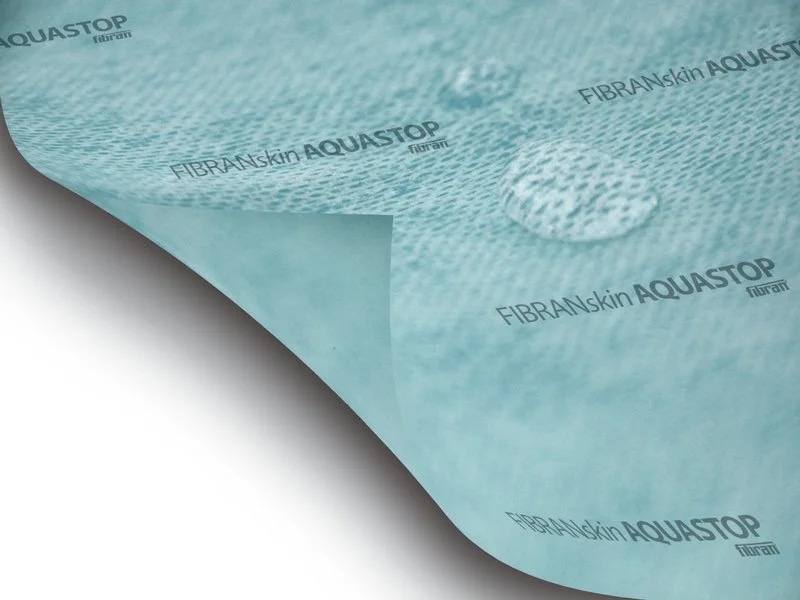
FIBRANskin AQUASTOP | Decoupling membrane for waterproofing in bathrooms and terraces
Cementitious waterproofing mortarsDescription
FIBRANskin AQUASTOP is a flexible waterproofing and decoupling membrane, manufactured in accordance with EN 13859-2. Just 0.52 mm thick and weighing 335 g/m², it is laid between the substrate and the ceramic tiles, where it performs two functions simultaneously: it prevents water ingress (PASS watertightness rating in accordance with EN 1928/B) and absorbs the differential movements of the substrate that cause tiles to crack. Elongation of 190 per cent in width and 23 per cent in length, tensile strength of 395 N/50 mm, static load resistance of 20 kg, flexibility down to –40 °C. Chemically stable in an alkaline environment in accordance with EN 1847. Available in rolls of 1.20 × 30 m (36 m²) and 1.20 × 5 m (6 m²).
The ARGYNET View
Why do tiles crack? Not because they are weak — their compressive strength is enormous. They crack because they are rigidly bonded to a substrate that moves: concrete shrinks as it dries, expands due to thermal changes, and deforms under load. The tile does not follow suit. The stress concentrates at the interface and is released in the only way it can — cracking, delamination, a ‘hollow’ tile.
Look at the TDS figures and you’ll understand the mechanism: 190 per cent elongation across the width versus 23 per cent along the length. This extreme anisotropy is not a manufacturing defect; it is by design. The sheet behaves like a directional spring — it stretches where it needs to absorb movement, and remains stable where it needs to hold the tile in place. And at the same time, it can withstand a static load of 20 kg: you can walk on the floor normally.
The key point that most people miss: the 50 m² limit is not a property of the material — it is a property of the exposure. On an exposed flat roof, where the membrane is subjected to the full temperature range, the limit applies. On an internal or inverted flat roof beneath XPS – where the thermal insulation protects the membrane – the limit disappears. So, if the project involves a 200 m² flat roof, AQUASTOP is not ruled out; it is simply that the correct solution is an inverted roof system with FIBRANxps on top.
Overview
Key Features
Uncoupling
-Maximum elongation 190 per cent across the width (T), 23 per cent along the length (L) — EN 12311-2/A
- Tensile strength 395 N/50 mm (L) and 130 N/50 mm (T)
-Dimensional stability -0.2 per cent (L) / 0 per cent (T) in accordance with EN 1107-2
Waterproofing
- Watertightness PASS in accordance with EN 1928/B
- Overlap seam strength 110 N/50 mm (EN 12317-2)
- Water vapour diffusion resistance 9.75 m²·h·Pa/mg (EN 1931:2001)
Mechanical & environmental resistance
- Static load resistance: 20 kg (EN 12730/B)
- Flexibility at low temperatures down to -40 °C (EN 495-5)
- Chemical stability: values remain unchanged after 28 days in a saturated calcium hydroxide solution at 23 °C (EN 1847) — crucial, as adhesives and cement mortars are highly alkaline
Related Products
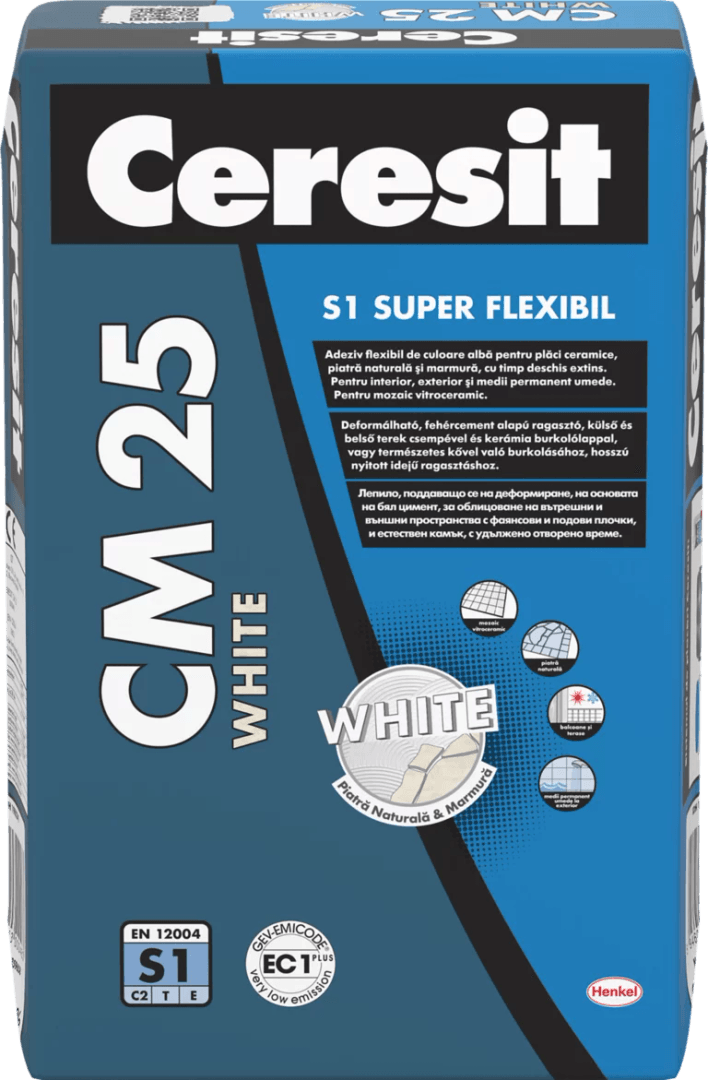
CERESIT CM 25 | C2TES1
Category: Tile adhesives
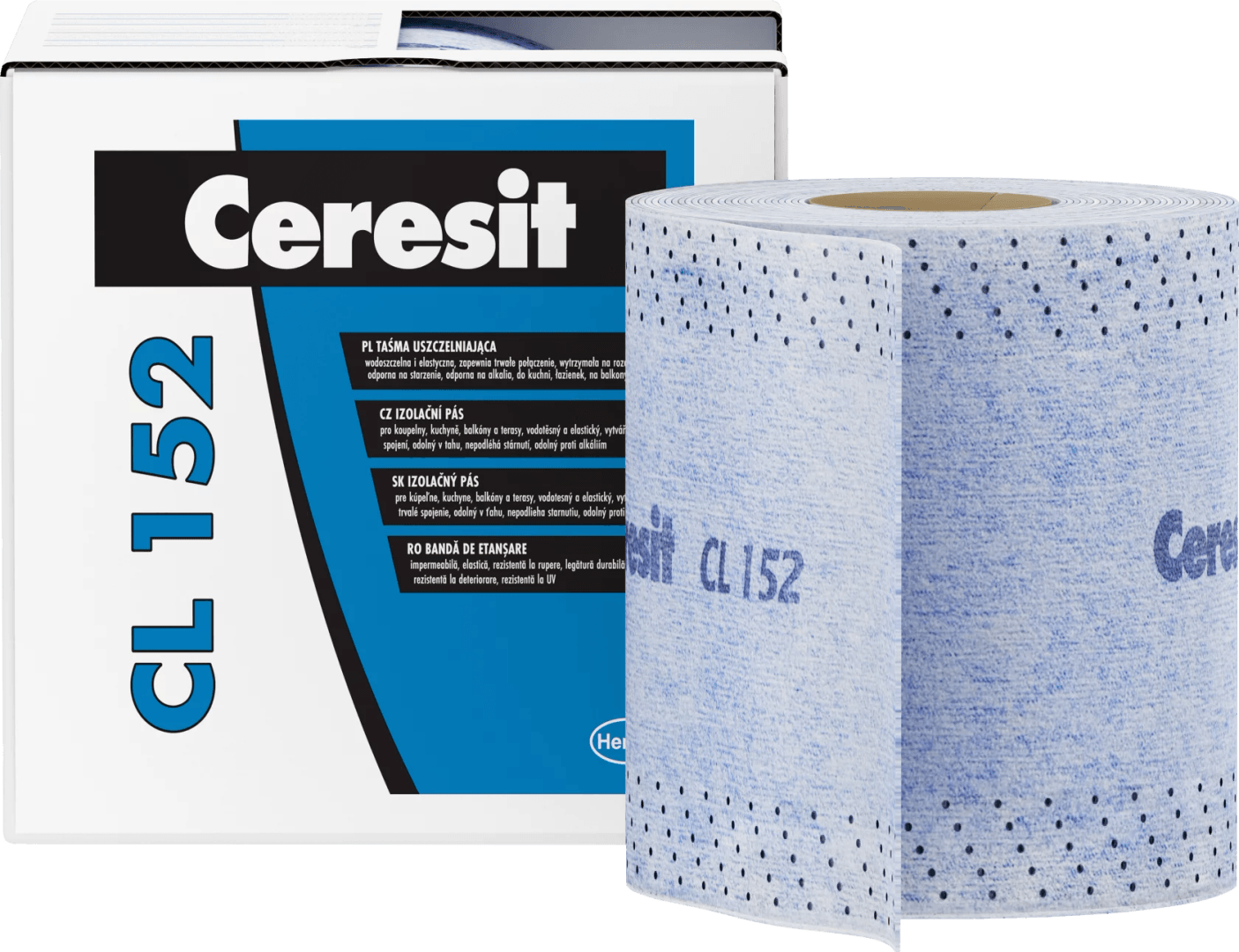
CERESIT CL 152 | Waterproofing membrane
Category: Cementitious waterproofing mortars
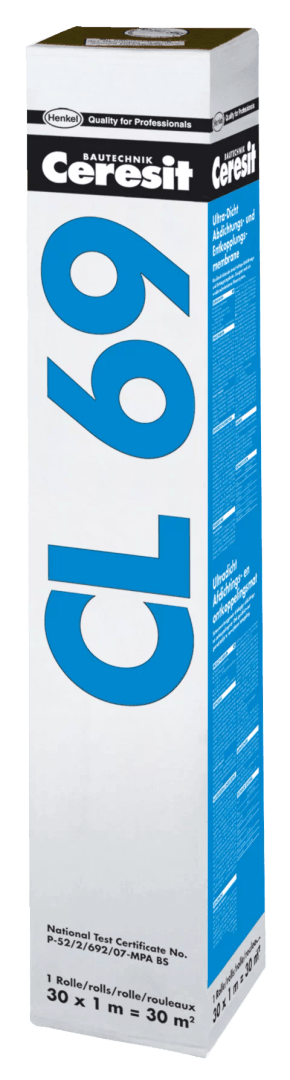
CERESIT CL 69 | Waterproofing and decoupling membrane
Category: Cementitious waterproofing mortars
CERESIT CM 49 PREMIUM FLEXIBLE | C2TES2
Category: Tile adhesives