FIBRANskin BARRIER 2400 | Synthetic vapour barrier membrane
Pitched roof waterproofing and insulationDescription
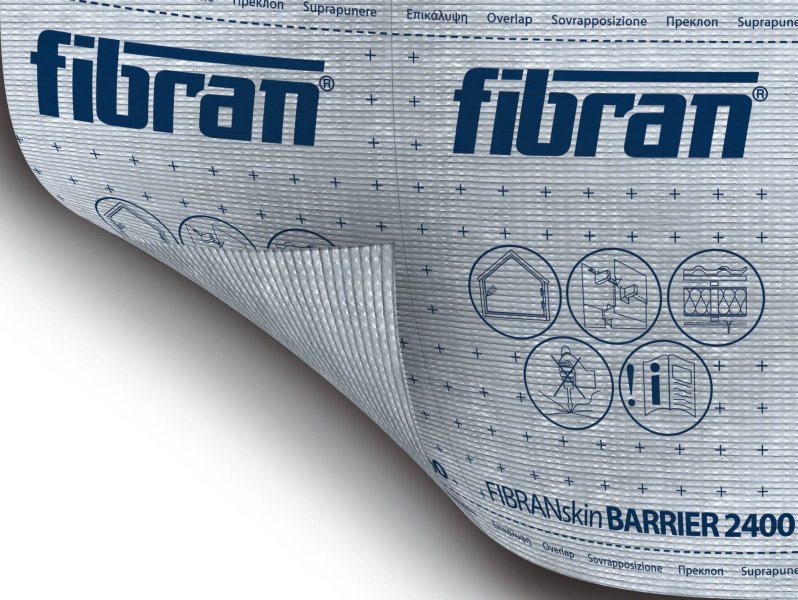
FIBRANskin BARRIER 2400 is a vapour barrier membrane in accordance with EN 13984:2013, with an aluminium foil on one side. Its water vapour diffusion resistance reaches Sd = 2400 m (minimum declared value 1500 m) — one of the highest values on the market. It is installed on the warm side, beneath the thermal insulation, in areas with very high humidity levels. At the same time, the aluminium coating acts as a reflective layer: emissivity of 0.05 in accordance with EN 15976 and thermal resistance of free air up to 0.66 m²K/W in accordance with EN ISO 6946. Fully airtight (Bendtsen 0 ml/min), with high resistance to nail tearing (280/300 N) and an operating temperature range of –40 °C to +80 °C. Thickness 0.31 mm, mass 122 g/m², roll 1.50 × 50 m. 25-year manufacturer’s warranty.
The ARGYNET View
‘2400’ is not a model code — it is the specification.
Sd stands for ‘equivalent air layer thickness’: how many metres of still air would be needed to achieve the same resistance to water vapour diffusion. BARRIER 2400 is equivalent to 2.4 kilometres of air. A standard polyethylene vapour barrier ranges from 50 to 100 metres. BARRIER 23 from the same range is 23 metres.
The difference is not quantitative — it is categorical, and makes a difference in specific projects:
- Cold rooms. The constant temperature difference creates continuous, one-way water vapour pressure. A 100-metre barrier allows enough moisture to pass through that, within a few years, the insulation becomes saturated and the chamber consumes twice as much electricity.
- Swimming pools, spas, laundries, industrial premises with steam. Where humidity is not seasonal but constant.
- Standard residential properties: the 2400 model is over-specified. The BARRIER 23 does the job at a lower cost.
The second argument, which doesn’t cost twice as much: aluminium provides an emissivity of 0.05 and a thermal resistance of up to 0.66 m²K/W in the adjacent air gap, certified to EN ISO 6946. This is a real, calculable value that is included in a design study — in contrast to reflective materials that advertise reflection rates without a specified R-value. Prerequisite: an undisturbed air gap in front of the aluminium. When in full contact with a solid material, only the barrier function remains.
Overview
Key Features
Vapour barrier
- Diffusion resistance Sd = 2400 m (minimum declared 1500 m), EN 1931
- Watertightness: Passed in accordance with EN 1928 (A)
- Resistance to artificial ageing: passed in terms of water vapour transmission properties
- Manufactured in accordance with EN 13984:2013
Reflective performance
- Emissivity 0.05 (EN 15976)
- Thermal resistance to free air: 0.66 m²K/W horizontal flow, 0.45 m²K/W vertical flow (EN ISO 6946)
Air-tightness
- Bendtsen air permeability: 0 ml/min (ISO 5636/3)
- Gurley air permeability: >2000 s (ISO 5636/5)
Mechanical properties
- Tensile strength 190 N/50 mm (MD) and 170 N/50 mm (XD)
- Elongation 20% (MD) and 30% (XD)
- Nail tear strength 280 N (MD) and 300 N (XD) — among the highest in the range
- Basis weight 122 g/m² (112–164), thickness 0.31 mm
- Roll size 1.50 × 50 m (75 m²)
- Operating temperature -40 °C to +80 °C
- 25-year manufacturer’s warranty
Where it is used
Technical solutions where this material is used.