Restoring an Old Bituminous Roof Membrane Without Stripping
Last updated:
Δύο στρώσεις ελαστομερούς γαλακτώματος, οπλισμός στα στηθαία και ανακλαστικό αλουμίνιο: έλεγχος δώματος, βήματα, στεγνώματα και υπολογισμός δοχείων.
The system at a glance
- ESHAELASTIC | Hyper-elastic bituminous waterproofing emulsion
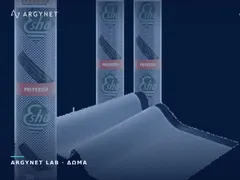
- ESHATERRA 50 | Polyester reinforcement for liquid-applied coating layers
- ESHALUMIN | Thermal-reflective & waterproof aluminium varnish
- ESHASEALER No1 | Asphalt joint sealant
- ESHALAC 50S | Bituminous Varnish / Primer
- ESHADIEN SBS -20 | Elastomeric bituminous membrane
- ESHADIEN ULTRAWHITE SBS -20 | Cool roof
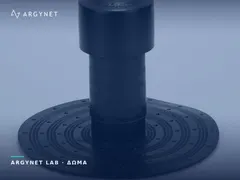
- Flat Roof Vent
Solutions & Applications · Roof Waterproofing
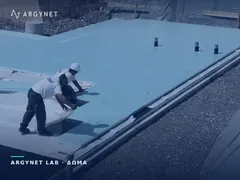
An old bituminous roof does not always need stripping. When the membrane is still bonded to the substrate but has faded, lost its mineral chippings and opened hairline cracks, it can be restored in place. Two coats of elastomeric bituminous emulsion, reinforcement at the critical details and a reflective aluminium top coat form a continuous, elastic membrane over the old one. No debris, no torch, and the building stays in use.
When restoration is enough — and when it is not
The decision depends on the condition of the existing membrane, not on its age. Before any quote, the roof is checked by eye and on foot:
| What you see on the roof | What it means | Solution |
|---|---|---|
| Faded membrane, loose chippings, hairline surface cracks | Sun ageing · the membrane is still bonded and watertight over most of the roof | Restoration with ESHAELASTIC and ESHALUMIN |
| Small leaks at parapets, corners, outlets or sheet laps | Local failure at the details, not across the surface | Restoration, with local repairs and ESHATERRA 50 reinforcement at those points |
| A few isolated blisters | Locally trapped water vapour | Repair the blisters first, then restore |
| Widespread blisters or membrane lifting over large areas | The membrane is no longer continuous with the substrate | Not restoration · a new bituminous membrane, with substrate venting |
| Ponding water, wet insulation underneath, damp ceiling throughout | A falls problem or a saturated layer below the membrane | Not restoration · rebuild with correct falls and thermal insulation |
Why it works
- Full compatibility with old bitumen: ESHAELASTIC is a bituminous emulsion modified with SBR latex. It bonds to the aged bituminous membrane, seals its cracks and stabilises the remaining chippings.
- Elasticity that follows the roof: elongation above 1000% (ASTM D-412) and bridging of a 3 mm crack with no flow, at 0 °C and at 20 °C. The new layer does not crack with thermal movement.
- A continuous, jointless membrane: it is brushed on like a paint and covers parapets, corners and penetrations without seams, exactly where sheets usually fail.
- No torch, no solvents: water-based, with VOC < 30 g/l. Applied cold by brush or roller, safely on occupied buildings.
- Reflective protection on top: ESHALUMIN has a measured reflectance of R = 72 in the visible and R = 77 in the near infrared (ASTM E 903-96). It reduces thermal stress on the bitumen, and so its rate of ageing, and keeps the roof cooler.
Application, step by step
- Inspection: walk the whole surface. Mark blisters, soft spots and lifting at parapets and outlets.
- Cleaning: remove dust, loose chippings, leaves and vegetation. Brush and wash so the surface is clean, free of oil and loose material. ESHAELASTIC can be applied on a damp surface, but not on standing water.
- Local repairs: blisters are cut open, dried and re-bonded or patched. Cracks and laps are sealed with ESHASEALER No1, which needs priming with ESHALAC 50S.
- First coat of ESHAELASTIC: applied cold with a natural-bristle brush or roller, evenly over the whole surface and the parapets.
- Reinforcement at the details: while the first coat is still wet, ESHATERRA 50 at parapets, corners, outlets, pipe penetrations and along cracks. The fabric is pressed in so that it is fully saturated.
- Second coat of ESHAELASTIC: crosswise to the first and only once the first is fully dry. Do not build a thick film in one go, so that no water is trapped between the coats.
- ESHALUMIN top coat: once the last coat of ESHAELASTIC is completely dry. It creates a reflective silver surface and also acts as a second waterproofing layer.
The most common failure in a restoration is haste. A second coat over a wet first coat traps water. ESHALUMIN over an emulsion that has not dried will not bond properly. Allow 2–3 hours of drying per coat in summer and 6–8 hours in winter, and do not start if rain is forecast within that window.
And do not coat over blisters: the new layer will lock them in, but it will not fix them.
Quantities & conditions
| Parameter | Value |
|---|---|
| ESHAELASTIC per coat | 0.3–0.4 kg/m², depending on surface porosity |
| ESHAELASTIC in 2 coats | 0.6–0.8 kg/m² · one 17 kg pail covers about 21–28 m² |
| Pail calculation | (m² of roof + m² of parapets) × 0.8 ÷ 17, rounded up |
| ESHATERRA 50 | Strips at parapets, corners, outlets, penetrations and cracks · measured in linear metres |
| Drying per coat | ≈ 2–3 hours in summer · ≈ 6–8 hours in winter |
| Application conditions | Temperature ≥ +5 °C · not in rain or frost |
| Tool cleaning | With water while the material is wet · with diesel or white spirit once dry |
As a guide, for a 100 m² roof with 20 m² of parapets: 120 × 0.8 ÷ 17 ≈ 6 pails of ESHAELASTIC. Parapets always count; they are where water usually gets in.
Restoration or new waterproofing?
| Option | When it fits | What it means for the job |
|---|---|---|
| Restoration with ESHAELASTIC + ESHALUMIN | Membrane bonded, aged on the surface, small local leaks | Fast work, no torch and no debris · yearly inspection and renewal of the reflective coat when it wears |
| New bituminous membrane over the old one | Widespread blisters, lifting, holes · substrate otherwise sound | Torch-applied, with substrate venting · ESHAELASTIC can be used as a water-based primer |
| Full rebuild with thermal insulation | Ponding water, wet insulation, need for energy upgrade | New falls, thermal insulation and waterproofing · the longest-lasting solution |
What we need to propose the system
- Roof area: m² of roof, height and length of parapets.
- Photos: a general view, close-ups of cracks and blisters, parapets and outlets.
- History: age of the membrane, where damp shows on the ceiling, whether water ponds after rain.
- Use: non-trafficable or trafficable roof, solar water heaters, air-conditioning units, plinths.
The System
When restoration is not enough
Related ARGYNET LAB Solutions
An old bituminous roof? Send us the m² and photos: we will tell you whether restoration is enough and calculate the quantities.
Request a Technical Quote