
Inverted Roof: Thermal insulation above the waterproofing
Last updated:
Insulation laid on top of the waterproofing is constantly exposed to water — which is why only XPS can withstand it. Layering, intermediate layer, ballast and d
The system at a glance
- FIBRANxps 300 | Flat roofs
- FIBRANxps INCLINE | Creating slopes
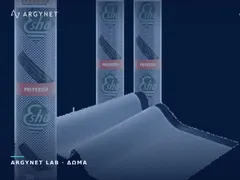
- ESHAGUM APP -10 | Polymer-modified bituminous membrane
- ESHACOAT 6S | Elastomeric bituminous emulsion
- ESHADESMOLAST | 1C polyurethane waterproofing
- CERESIT CR 166 Flexible 2-K | Flexible cementitious waterproofing compound
- FIBRANskin SEAL | Rainwater management membrane
- QDRAIN C20 65 10F | 20 mm drainage geosynthetic
- FIBRANfilter SF32 | PP geotextile
- ESHAPROTECT | HDPE protective membrane
- VANDEX UNIMORTAR 1 | Waterproofing and repair mortar
- ESHAHYDROBENT | Water-swelling bentonite cord - waterstop
Solutions & Applications · Waterproofing & Insulation
In a conventional flat roof, the waterproofing is the exposed element: it is subjected to ultraviolet radiation, temperatures ranging from −5 to +80 °C and all manner of mechanical stress. In an inverted roof, the order is reversed and the waterproofing is placed beneath the insulation — where it remains at a virtually constant temperature, in the dark, and protected. This is not a variation; it is a different philosophy of service life.
The benefits of waterproofing
| Stress | Conventional flat roof | Inverted roof |
|---|---|---|
| Temperature cycles | Daily temperature range of tens of degrees, thousands of cycles per year | Virtually constant temperature — the insulation absorbs temperature fluctuations |
| Ultraviolet radiation | Direct exposure, material ageing | Zero |
| Mechanical stress | Accessibility, hail, maintenance works | Protected by insulation and ballast |
| Vapour barrier | This is usually required, at the risk of incorrect positioning | The waterproofing itself acts as a barrier, on the correct side |
| Traffic | Visible but exposed | The ballast and insulation are removed and reinstalled |
In an inverted roof, the insulation is permanently exposed to rainwater. This rules out almost any thermal insulation material: anything that absorbs moisture loses its thermal performance within a few seasons and does not recover it.
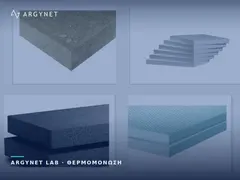
XPS is the material that withstands these conditions, thanks to its closed microcellular structure: practically zero water absorption, resistance to freeze-thaw cycles and mechanical strength to support the overlying ballast. EPS, mineral wool or polyurethane are not viable alternatives in this application — regardless of the cost or the l-factor stated in the brochure.
At ARGYNET, we specify the entire stratification and calculate materials per m².
Layering from the bottom up
- Concrete slab — clean, dry and free from any spalling.
- Solutions: creating slopes towards drainage points. Where this is achieved using insulation material of variable thickness, weight is saved and thermal resistance is added instead of the dead load of mortar.
- Priming of the surface prior to the waterproofing layer.
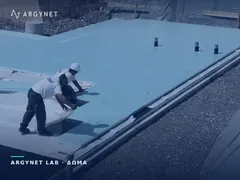
- Waterproofing layer — bituminous membrane, liquid-applied polyurethane coating or cementitious coating, depending on the conditions and specific requirements.
- XPS thermal insulation boards in one or two layers, laid loosely, with joints in contact.
- A filter geotextile separator between the insulation and the ballast.
- Ballast: washed gravel or paving slabs on supports.
Two layers with offset joints
Where the required thickness is achieved with two layers, the boards are laid crosswise. A continuous joint running through the entire thickness acts as a linear thermal bridge along its entire length and, at the same time, provides a preferred route for water to reach the waterproofing.
The intermediate layer: three options, three performance levels
A layer is always placed between the insulation and the screed. The choice of this layer is not merely a matter of cost — it determines how much water will end up beneath the insulation, and thus how much the thermal performance of the flat roof will be compromised.
| Selection | What it does | Water beneath the insulation |
|---|---|---|
| Geotextile filter FIBRANfilter SF32 | It separates the backfill from the insulation; water passes freely through the joints | Full flow — maximum thermal transmittance correction |
| Drainage geosynthetic QDRAIN C20 65 10F | It creates a 20 mm drainage channel above the insulation, with an integrated filter | Reduced — a large portion is sold off before it goes on sale |
| Rainwater management membrane FIBRANskin SEAL | A waterproof layer that diverts rainwater before it reaches the insulation, whilst remaining breathable | Minimum — optimum thermal performance |
Geotextile: here, the large pore size is the key requirement
This is the point where the inverted roof reverses the logic behind the choice of geotextile. In groundworks, we require a small pore size to retain fine-grained material. Here, however, we require zero water retention: water must be able to flow freely downwards and drain away. A geotextile with a small pore size gradually becomes clogged and traps moisture above the insulation.
FIBRANskin SEAL: waterproof yet breathable
It is the combination of these two properties that solves the problem, and it is not obvious:
- W1 waterproofing class — rain does not penetrate downwards.
- Water vapour diffusion resistance Sd = 0.01 m — practically unrestricted upward vapour diffusion.
In other words, rainwater is diverted and channelled to the drainage system, whilst water vapour reaching the insulation from below can escape. A simply waterproof membrane would trap moisture within the system; here, the flow is one-way, outwards.
The remaining dimensions document the performance on site: functional layer thickness 175 μm, tensile strength 310 N/50 mm, nail tear strength 50 N and temperature range −40 to +100 °C. Joints must be sealed using FIBRANtape BUTYL-2-sided double-sided butyl tape — simply overlapping the edges is not sufficient.
The same membrane also acts as a protective separating layer prior to the application of mortar, where the flat roof will be covered with cement mortar and a final finish.
QDRAIN C20 65 10F: when there is a lot of water
The 20 mm drainage geocomposite provides an active drainage channel above the insulation, with the filter geotextile already incorporated. It is selected for flat roofs, in areas with heavy rainfall, or where the distance to the drain is long and the water would otherwise have time to run off.
Thermal transmittance correction
In an inverted roof, some of the rainwater flows between the slabs and the waterproofing before reaching the drain. This flow removes heat and constitutes a real loss, which the regulations address by applying a surcharge to the calculation of thermal transmittance.
The allowance depends on the rainfall in the area, the drainage arrangement and the thickness of the insulation. In practice, this means that the thickness of the inverted roof is calculated to be slightly greater than would be required to achieve the same performance in a conventional system. If this correction is omitted, the flat roof fails to meet the design target — and the discrepancy is not apparent until the energy audit.
This is precisely where the value of the intermediate layer lies. The less water that reaches beneath the insulation, the smaller the surcharge. A waterproof rainwater management membrane diverts rainwater before it even begins to run off, whilst a drainage geosynthetic carries it away from the top, whilst a simple geotextile allows it to pass through entirely. The choice of layer is not just a matter of protection — it is a factor in the energy calculation, and is often cheaper than adding extra insulation thickness.
Ballast is not decorative
XPS boards are lightweight and float. The ballast fulfils three functions simultaneously:
- Wind pressure compensation: the load is calculated based on the wind zone, the height of the building and the position on the flat roof — the perimeter zones and corners require more than the centre.
- Buoyancy compensation: during heavy rainfall, slabs tend to be lifted by water flowing from below.
- UV protection: XPS must not be left uncovered — ultraviolet radiation degrades its surface.
The gravel is washed and rounded, with a grain size that does not pass through the geotextile. Angular fragments with fine grains clog the system and damage the insulation.
The drainage systems operate on two levels
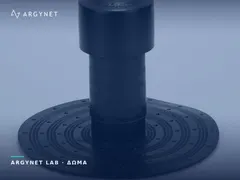
It is the detail that is most often overlooked, because it runs counter to intuition: on an inverted roof, water does not drain away from the surface but from the waterproofing layer, beneath the insulation.
- Double-inlet gutter: it must be capable of receiving water both at the waterproofing level and at the surface of the ballast.
- Entrance protection: a grate or drain that does not become blocked by gravel and leaves.
- Access point: a point that is cleaned without removing the entire ballast.
A gutter that only collects water at the surface leaves a permanent pool on top of the waterproofing — which is precisely the situation that an inverted roof is supposed to prevent.
Perimeter details
- Fill the corners where the slab meets the parapet with a waterproofing repair mortar, prior to applying the waterproofing layer.
- Extension on parapets higher than the final ballast level, with mechanical fixing and finishing.
- Penetrations: pipework, equipment bases and fixings must be sealed individually before the insulation is installed.
- Expansion joints: the waterproofing membrane follows the movement without opening up.
- Perimeter zone: increased ballast or mechanical retention, depending on the wind pressure calculation.
Design series
- Flat roof use: non-accessible with gravel, trafficable with slabs on supports or a green roof — this affects ballast, loads and details.
- Slab load-bearing capacity: ballast adds a significant permanent load.
- Calculation of thermal insulation with rainwater flow correction.
- Wind pressure: flat roof zones and required ballast weight per zone.
- Drainage system on two levels, with access for maintenance.
- Selection of waterproofing material according to geometry: membrane on flat surfaces, liquid-applied coating where details are paramount.
- Solutions: using variable-thickness insulation or mortar, depending on the available height and load.
Thermal Insulation for Inverted Roofs
Waterproofing Layer
Intermediate Layer above the Insulation
Protection & Details
Related Solutions from ARGYNET LAB
Does your gutter take in water at the waterproofing level?
Request a Technical Quotation