Applications of Glass-Mat Board in Modern Building Systems
Last updated:
Plasterboard, glass-mat board or cement board? They are not interchangeable. Where each is used — and the three key points that determine the façade.
The system at a glance
Solutions & Applications · Dry Construction
The development of dry construction systems has brought to the fore materials that combine speed of construction with outstanding durability. Glass-mat board is at the forefront of this development: it provides solutions where traditional plasterboard reaches its limits — in outdoor areas and in high-humidity environments.
What is glass-mat board and why should you choose it?
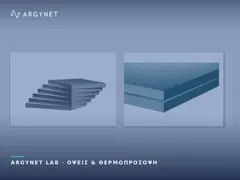
Glass-mat board is a technologically advanced panel with a gypsum core reinforced with special additives, which is covered on both sides with glass-fibre mesh instead of paper. It is precisely this replacement of paper with glass fibre that makes the difference: paper absorbs water, fosters mould growth and decomposes — glass fibre does not.
- Complete resistance to damp and mould: it does not absorb water and does not decompose.
- High mechanical strength: resistance to impact and weather conditions, with minimal expansion and contraction due to temperature fluctuations.
- Vapour permeability: allows the building to ‘breathe’ by allowing water vapour to escape.
- Speed: it is cut and fitted in the same way as plasterboard, drastically reducing labour time.
Glass-mat board, plasterboard or cement board?
The three ‘pillars’ of dry construction are not interchangeable. The choice is made on the basis of the environment:
| Slab | Core / Cladding | Where it is used |
|---|---|---|
| Plasterboard | Plaster + paper | Interior, dry spaces. |
| Glass-mat board (Glasroc X / GUARDEX) | Plaster + glass fibre mesh (paper-free) | External masonry, wet areas, ETICS substrates and ventilated façades. Shelf life of up to 12 months. |
| Cement board (AQUAPANEL) | Cementitious core + glass fibre mesh | Direct/continuous contact with water, external areas, floors. |
Main applications
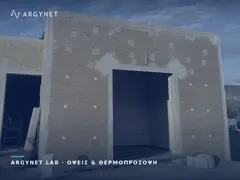
- External walls of dry construction: these replace traditional brickwork on façades, offering excellent thermal and sound insulation when combined with the appropriate insulation material.
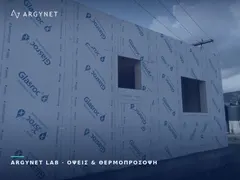
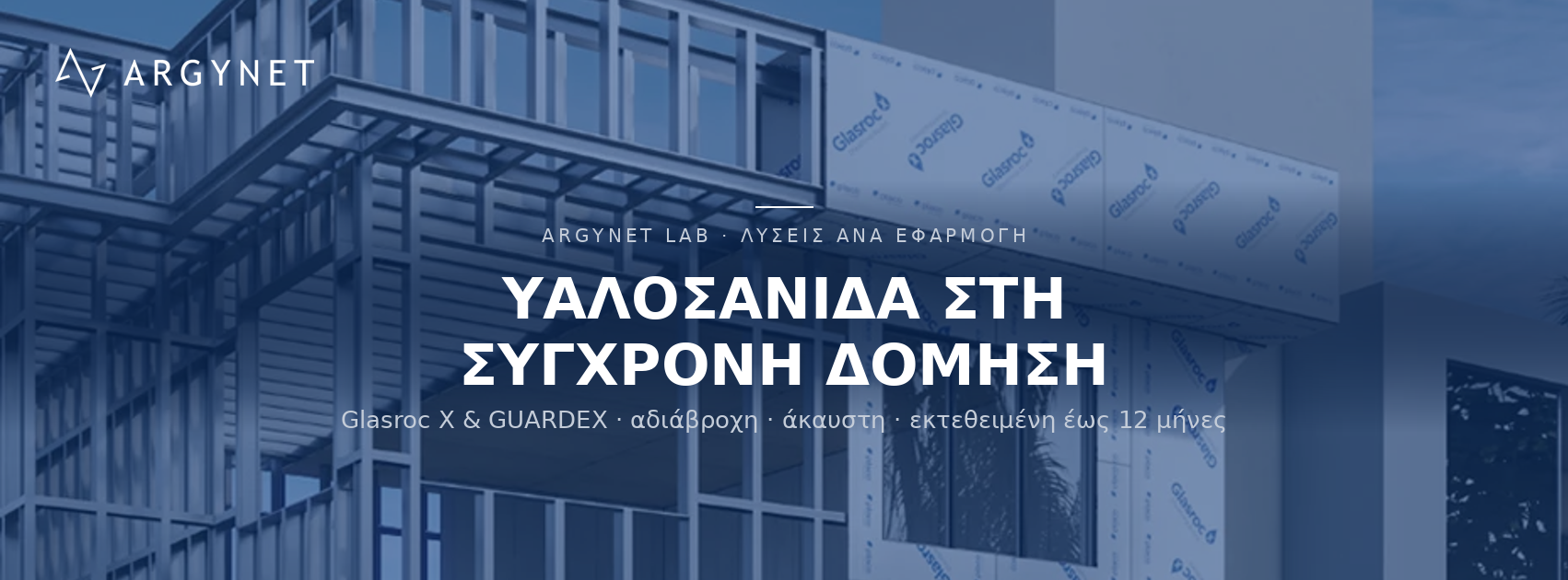
- Light steel framing: an ideal substrate for light steel framing constructions, as shown in the application image.
- Areas with high humidity: bathrooms, indoor swimming pools, spas, basements.
- Facade and roof cladding: cornices, eaves and decorative beams exposed to the elements.
The system: how glass-mat board works properly
Glass-mat board is not a stand-alone panel — it is the external ‘skin’ of a system. A typical dry-construction external wall comprises: a metal framework suspended from the load-bearing structure, stone wool between the studs for thermal and sound insulation, plasterboard on the inside and glass-mat board on the outside. An external thermal insulation composite system (ETICS) or a ventilated façade is then applied to this.
Three factors determine the outcome:
- The correct screw: Glass-mat board must be fixed with screws offering enhanced corrosion protection, suitable for external/damp environments — not with standard plasterboard screws, which will rust.
- Joint treatment: weather resistance and the ability to withstand exposure for up to 12 months depend directly on the joints being properly sealed using the specified materials.
- Filling the framework: stone wool in the cavities — for sound insulation, thermal insulation and fire protection.
The two top choices from ARGYNET
GUARDEX 12.5 mm (Knauf)
Non-combustible glass-mat board (type GM-FH1R in accordance with EN 15283-1+A1, reaction to fire class A1), resistant to water, mould and weather conditions, lightweight. Ideal substrate for external thermal insulation systems (Knauf Thermoprosopsis) and ventilated façades. A favourite choice among technicians for the rapid, safe cladding of buildings.
Glasroc X (Saint-Gobain / Rigips)
High-performance white glass-fibre-reinforced board, free from cellulose, with a special treatment applied to the outer glass fibre mesh, giving it exceptional resistance to ultraviolet (UV) radiation and temperature fluctuations. It can remain exposed for up to 12 months and is used as a substrate for ETICS as well as for direct rendering with specialised cementitious materials — ideal for external ceilings, parapets and façade cladding systems.
Glass-mat board is a substrate, not a final waterproofing surface. Its durability is determined by three factors that are not immediately apparent: the correct corrosion-resistant screw, meticulous joint sealing and the appropriate finishing system on top (ETICS or ventilated façade). Failure to ensure any one of these will negate the ‘up to 12 months’ exposure’ and the façade’s longevity.
Second point: do not confuse glass-mat board with cement board. In areas of direct and continuous contact with water (floors in wet rooms, external plinths), AQUAPANEL cement board is the correct choice.
At ARGYNET, we specify the entire external wall system — framework, insulation, glass-mat board, screws, jointing materials and finishing coat — and calculate materials per m².
Related Products & Categories
Are you designing external masonry or a façade using glass-mat boards?
Request a Technical Quotation