EPS vs XPS: Which should I choose for External Thermal Insulation? (Comparison Guide)
Last updated:
The question ‘EPS or XPS?’ is misguided. Each material has its own area of application — and the two costly mistakes are the exact opposites of one another.
The system at a glance
- FIBRANgeo BP-ETICS | Stone wool for External Thermal Insulation
- TERMOPOR EPS-80 | White
- GRAFIT EPS-80 | Graphite-based
- FIBRANxps ETICS GF | External Wall Insulation
- CERESIT CT 82 | Adhesive mortar & Base coat
- CERESIT CT 327 | Glass fibre mesh
- KLIMAS LTX10 | Thermal Insulation Plugs
- CERESIT CT 74 | Silicone-based finishing render
- CERESIT CT 16 | Acrylic primer
- FIBRAN CAPS | ETICS Plug Covers
- CERESIT Thermo Universal | Fibre-reinforced base coat mortar
Solutions & Applications · External Thermal Insulation Composite Systems (ETICS)
The question ‘EPS or XPS?’ is misguided. There is no superior material — there is a suitable material for each zone of the façade. Incorrect installation leads to two specific failures: cracks in the final render when a rigid material covers the entire surface outside a certified system, or deterioration of the substrate when a flexible material is exposed to the splash zone.
EPS — The Material for Main Wall Construction
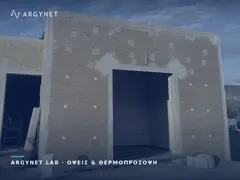
EPS, particularly in its graphite-modified form, covers the majority of the façade in a properly designed ETICS system.
- Vapour permeability: allows water vapour to escape outwards, preventing moisture from becoming trapped within the structure and the formation of mould.
- Elasticity: absorbs the expansion and contraction and vibrations of the load-bearing structure, reducing the risk of cracking in the finishing layer.
- Technical and economic performance: lower cost per m² compared to XPS, with high thermal insulation performance.
- Workability: can be easily rasped, allowing for levelling adjustments to be made directly on site.
Extruded XPS — The Shield for Critical Areas
A material with a closed-cell structure, significantly harder and more compact. It is not a substitute for EPS on façades — it is the solution for areas where EPS is insufficient.
- Moisture resistance: virtually zero water absorption — remains effective when in constant contact with water or soil.
- Mechanical strength: high compressive and impact resistance, where the façade is subject to stress.
- Limitations on the façade: its rigidity does not ‘accommodate’ the building’s movements, whilst its low vapour permeability may trap moisture if applied across the entire surface.
For use in external wall insulation, XPS must be a skinless board or one with a corrugated/grooved surface. The smooth ‘skin’ of a standard XPS board does not provide sufficient adhesion to the bonding mortar.
Comparison Table
| Feature | EPS (Expanded) | XPS (Expanded) |
|---|---|---|
| Breathability | Moderate — greater than that of XPS | Very low — closed-cell |
| Flexibility | Absorbs movements of the building | Rigid — increased risk of cracking |
| Water absorption | Limited | Practically zero |
| Mechanical strength | Suitable for masonry | High compressive strength and impact resistance |
| Adhesive adhesion | Immediate | Requires a smooth or embossed surface |
| Workability | Grinding — levelling correction | Difficult to sand |
| Cost per m² | Lower | Higher |
| Ideal location | Main masonry | Foundation, concrete, ground contact |
Where vapour permeability is the main concern — old masonry, moisture in the building envelope — the solution is neither of the two polystyrene types but stone wool, with a water vapour diffusion resistance practically equal to that of air.
The ARGYNET Proposal: Facade Zoning
The optimal technical and economic solution is not a choice of a single material, but the correct allocation of both:
| Building Zone | Material | Justification |
|---|---|---|
| Main masonry (~90 per cent of the surface area) | Graphite-filled EPS | Breathability, elasticity, optimal cost |
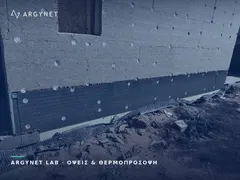
| Base zone — the first 30–50 cm from the ground | XPS | Splash zone, rising damp, impacts |
| Concrete elements (beams, columns, cantilevers) | XPS | Thermal bridges & mechanical stress |
| Walls in contact with the ground | XPS | Permanent exposure to moisture |
The Three Mistakes That Cost Money
- Plain XPS across the entire façade, outside a certified system: trapping of water vapour and cracking of the render due to structural movement. Where there is a valid reason for using XPS across the entire façade — seismic reinforcement, impact resistance, tiling — it must only be applied as a certified system using FIBRANxps ETICS GF.
- EPS down to ground level: the splash zone and rising damp cause deterioration at the base of the system.
- Standard XPS board with a skin: insufficient adhesive bond — detachment of the system at the base zone.
The thermal insulation material consists of a single layer. The performance and service life of the external wall insulation depend on the completeness of the system: adhesive mortar, mechanical fixing with dowels, a reinforced base coat with glass fibre mesh, a primer and a finishing render — all from a compatible, certified product range.
At ARGYNET, we specify the entire ETICS system by zone and calculate materials per m².
Related Products & Categories
Related Solutions from ARGYNET LAB
Are you designing an external wall insulation system and would you like a proposal for materials by zone?
Request a Technical Quotation