Self-cleaning silicone-based renders
Last updated:
Rain runs off and washes away dirt; moisture dries out. Water-repellent W3 and breathable V1 combined — but always with CT 16 primer underneath.
The system at a glance
- CERESIT CT 74 | Silicone-based finishing render
- CERESIT CT 16 | Acrylic primer
- CERESIT CT 327 | Glass fibre mesh
- CERESIT Thermo Universal | Fibre-reinforced base coat mortar
- TERMOPOR EPS-100 | White
- CERESIT CT 48 Silicone-based Paint
- CERESIT CT 49 | Nano-silicone-based paint
- FIBRANgeo BP-ETICS | Stone wool for External Thermal Insulation
Solutions & Applications · External Thermal Insulation
Greek climatic conditions — high temperatures, intense solar radiation and humidity in coastal areas — require a finishing render with exceptional elasticity, breathability and durability. Ceresit CT 74 silicone-based render combines superior thermal insulation with cutting-edge technology, resulting in a façade that remains clean and pristine for years.
Why use a silicone-based render?
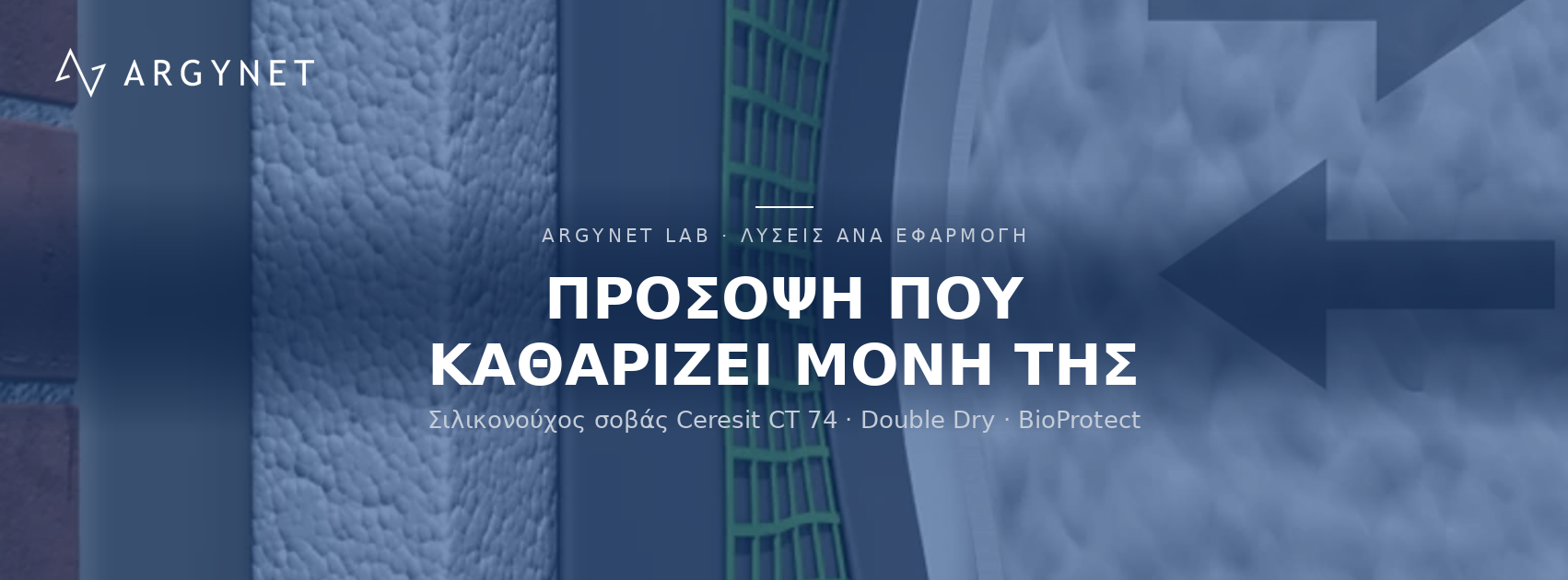
Double Dry technology — self-cleaning surface
The combination of two properties makes all the difference: the surface is highly hydrophobic (very low water absorption, class W3, < 0.5 kg/m² in 24 hours) and, at the same time, has excellent water vapour permeability (class V1, Sd ≤ 0.14 m according to EN 15824). Raindrops do not penetrate — they roll down the façade, washing away dirt, whilst any moisture dries quickly. The building ‘breathes’ and stays dry, even in high-pollution urban environments.
BioProtect formula — protection against mould and algae
Special biocides incorporated into the render mix provide permanent protection against fungi, mould and algae — for the entire lifespan of the plaster, without the need for separate treatment. This is crucial on north-facing walls and in areas with high humidity.
Elasticity & crack resistance
Significant temperature fluctuations cause contraction and expansion. The high elasticity of silicone-based render prevents hairline cracks, providing a protective barrier that is not damaged by the sun or frost.
Technical specifications
| Recommendation | Water-based dispersions of silicone and acrylic resins with mineral fillers |
| Grain size distribution | 1.5 mm (and 2.0 / 2.5 mm) — stone texture |
| Vapour permeability | Category V1, Sd ≤ 0.14 m (EN 15824) |
| Water absorption | Category W3, < 0.5 kg/m² (24 h) |
| Adhesion | 0.6 MPa |
| Reaction to fire | B-s1,d0 (σε Ceretherm Classic/Premium/Wool)· B-s2,d0 (σε Impactum / Universal XPS) |
| Consumption | ≈ 2.1–2.5 kg/m² (particle size distribution 1.5 mm) |
| Rain resistance | 24–48 hours (depending on the temperature) |
| Packaging | 25 kg container (100% recyclable) |
Application & insulation system
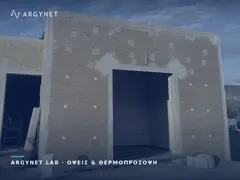
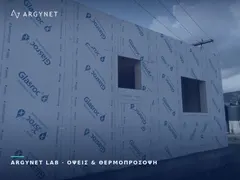
CT 74 is applied as the final, decorative layer in external thermal insulation composite systems (ETICS) using EPS boards or stone wool — ideally stone wool, due to its increased water vapour permeability. Key application points:
- Prime first: apply over a dry coat of Ceresit CT 16 primer — never directly onto the base coat.
- Conditions: ambient/substrate temperature +5 °C to +25 °C, humidity < 80 per cent. Protect from direct sunlight, rain and frost whilst drying.
- Application method: apply with a stainless steel trowel to the thickness of the grain, finish with a plastic float using circular movements. Apply to a single surface without interruption, maintaining the same consistency. Suitable for mechanical application.
- Renovation: future repainting of the façade with Ceresit CT 48 / CT 49 silicone-based paint, without removing the render.
Colour: the entire Colours of Nature® palette, offering exceptional colour stability and resistance to UV radiation. For very dark shades on large surfaces, CT 74 is recommended for architectural details — for a dark, ‘solid’ façade, see the Ceresit Ceretherm Solar Protect (CT 76) system with UV Protect technology.
The comprehensive ETICS system
From masonry to the finished surface:
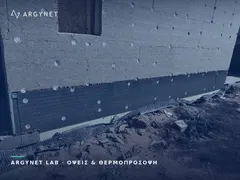
- Bonding of insulation — Ceresit Thermo Universal (EPS / XPS / stone wool).
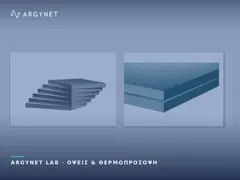
- Thermal insulation board — TERMOPOR EPS-100 or FIBRANgeo BP-ETICS stone wool.
- Reinforced base coat with Ceresit CT 327 glass fibre mesh.
- Primer for adhesion — Ceresit CT 16.
- Top coat — Ceresit CT 74, silicone-based self-cleaning render.
CT 74 ‘shines’ where breathability matters: in stone wool systems and in coastal buildings. Its Class V1 vapour permeability allows the façade to dry out, whilst its hydrophobic properties keep out rainwater and salt spray.
Two rules that must not be disregarded: always apply CT 16 primer before CT 74, and for very dark colours on large surfaces, choose Solar Protect (CT 76), not a standard silicone-based product. The top coat performs as part of a certified system (ETA) — mixing products from different systems will invalidate the warranty.
At ARGYNET, we specify the entire system and calculate materials per m².
Benefits for the owner
- Reduced maintenance costs: less need for repainting or repairs.
- Energy saving: when combined with the correct thermal insulation, this results in a significant reduction in heating and cooling losses.
- Increased property value: top quality and timeless aesthetics.
Related Products & Categories
Are you ready to protect your building?
Request a Technical Quotation