Erosion Protection for Slopes after Wildfire: Geomats, Geocells and Anchoring
Last updated:
A burnt slope is lost in the first rain. Geomat, reinforced geomat or geocells, correct anchoring and runoff drainage — all in place before autumn.
The system at a glance
- MacMat R | Geomat with reinforcement
- MacMat | Corrosion Control Geomat
- MacWeb | Geocells for Encapsulation & Corrosion Control
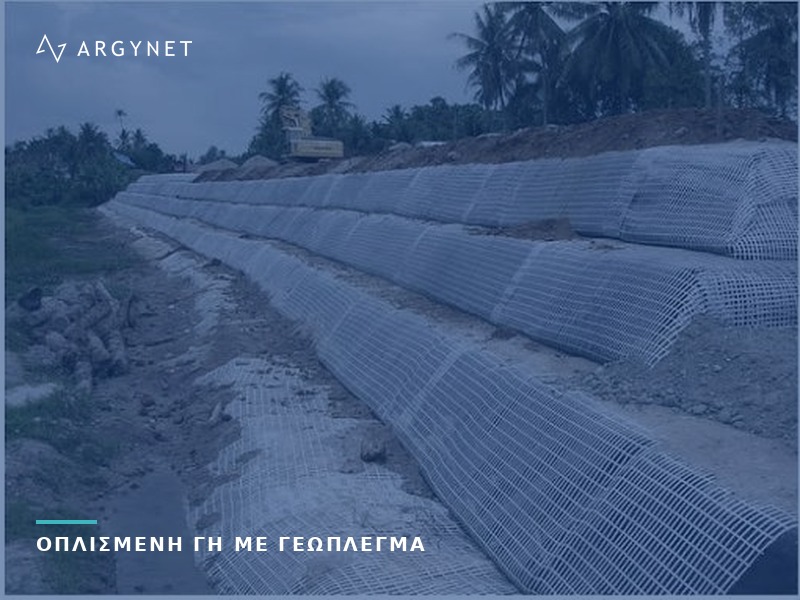
- ForGrid P | Uniaxial Polyester Geogrids for Reinforced Soil
- EPS Geofoam | Expanded Polystyrene Blocks for Lightweight Fill and Civil Engineering
- NW Standard | Non-woven polypropylene geotextile
- GEODRAIN PLUS | Drainage pipe with geotextile
Solutions & Applications · Erosion Protection
After a wildfire, the critical clock is not vegetation regrowth — it is the first heavy rain. Whatever has not been protected by then is lost. And it is not only soil that goes: the seed bank, the organic matter and the slope's own ability to regenerate go with it.
Why a burnt slope does not behave like a bare slope
Fire does not just remove vegetation. It changes the soil itself, and the four changes act together:
| Change | Effect on erosion |
|---|---|
| Loss of plant cover | Raindrops hit the soil directly — particle detachment and surface sealing |
| Loss of the litter layer | Runoff is no longer intercepted and slowed down |
| Soil water repellency | Organic compounds vaporise and condense a few centimetres below the surface, forming a layer that repels water. Infiltration collapses and runoff multiplies |
| Loss of root cohesion | Dead roots decompose gradually — the mechanical cohesion of the soil decreases for years after the event |
The third row is the one that surprises: a burnt slope can produce several times the runoff of a naturally bare slope of the same gradient, because the water does not soak in. That is why post-fire floods are triggered by rainfall that would have been insignificant before the event.
The contractor is not buying soil protection — they are buying time. The geosynthetic's job is to hold soil and seed in place until the root system takes over. From then on, vegetation is the permanent solution.
This has a direct consequence for scheduling: the job is judged not by its handover date but by whether it was completed before the first autumn rains. Work in November on a slope that burned in July has already missed the most critical event.
At ARGYNET we specify by gradient and soil type, and calculate materials and anchors per 1,000 m².
The three surface-protection technologies
| Material | Mechanism | When it is chosen |
|---|---|---|
| MacMat · Erosion-control geomat | Three-dimensional matrix of synthetic monofilaments, heat-bonded at the crossings · porosity typically above 90 % · UV-stabilised, non-degradable | Cut and fill slopes to be vegetated, burnt and bare land — the matrix fills with soil and seed and roots grow through it |
| MacMat R · Reinforced geomat | The three-dimensional matrix encased in double-twist steel mesh or a synthetic geogrid · Zn-Al 5 % wire · 120-year design life of the mesh | Steep and fire-damaged slopes, surface stabilisation with soil nailing — where holding the surface is not enough and stiffness and puncture resistance are needed |
| MacWeb · Geocells | Cellular system made of continuous high-density polyethylene sheets, without welds · three-dimensional confinement of soil or aggregate · certified service life up to 100 years | Very steep gradients or poor soil, where the infill must be held mechanically so it does not slide down · also channels and drainage ditches |
The selection criterion is twofold: how steep the slope is and how realistic natural regeneration is. Where vegetation will return, a geomat is enough and disappears from view within the plant cover. Where the soil is shallow, stony or the gradient marginal, cellular confinement is the solution that keeps the infill in place. Where erosive forces are higher, a reinforced mat is chosen.
Porosity is the key property, not strength
In erosion-control materials the critical figure is not strength but porosity. The reason is functional:
- Soil fills the matrix instead of sitting on top of it. After installation, good-quality topsoil is spread and brushed into the three-dimensional structure — that is where the mechanism lies, not in the material itself.
- Seed finds a substrate and is protected from being washed away, while still receiving light and water. The mat accepts hydroseeding and shrub planting.
- Roots grow through and anchor the whole — matrix, soil and vegetation become one body.
- Surface runoff slows down within the pores, loses energy and never reaches the velocity that carries particles away.
The permanence of the synthetic material does not work against vegetation: the matrix stays in the soil as a permanent reinforced zone, even once it can no longer be seen. In areas with frequent wildfires, that is the argument — after the next event, the protection is already there.
Anchoring decides the job
- Crest trench: the material is buried in a trench at the top of the slope. If the edge is left free, water gets in from above and lifts the entire sheet.
- Number and type of anchors: pin density is set by the design according to gradient and soil type. This is where savings are made on site — and where the job fails.
- Overlaps in the direction of flow: the upslope sheet overlaps the downslope one, so that water runs over the joint and not into it.
- Full contact with the soil: any gap between the matrix and the slope becomes a path for undermining. The surface is smoothed before installation.
- Toe of the slope: the downslope edge is terminated and anchored — never left "hanging".
The runoff has to go somewhere
This is the most common omission in restoration works. The erosion-control layer holds the soil but does not reduce the volume of water — and in a burnt catchment that volume is several times the usual because of water repellency.
Without organised drainage, water collects at the base of the slope, undermines the toe and the whole slope fails from the bottom up — while the surface looks intact. The design provides crest and toe ditches, perforated pipes with a geotextile filter and outfall points, together with the choice of geomat, not afterwards.
When the problem is not at the surface
Erosion protection solves a surface problem: the particle that washes away in the rain. It does not solve stability. If the slope shows cracks at the crest, bulging at the toe or has already slipped, the geomat will slide down with the soil it covers. There the solution is geotechnical, and the geomat comes last, as the final layer:
| Problem | Technique | What it offers |
|---|---|---|
| Steep slope that has to be rebuilt · landslide repair | Reinforced fill with ForGrid P uniaxial geogrid | Machine-direction (MD) strength 40–600 kN/m and 120-year long-term design strength (LTDS) declared for every code · MD laid perpendicular to the face, in layers to the design |
| The weight of the fill loads unstable or compressible ground | Lightweight fill with EPS Geofoam | Weight 0.5–2.5 % of conventional fill · EN 14933, CE marking · reduces the load on the slip surface |
| Water behind or beneath the reinforced block | Drainage with GEODRAIN PLUS | Perforated pipe with a geotextile filter · removes water without washing out fines |
Layers, anchorage lengths, fill material and drainage are set by the geotechnical stability design. A geomat or geocells on the face protect the surface of the new slope from erosion.
What the tender asks for
In public works — forestry services, regional authorities, funded restoration programmes — the technical offer is judged on documents:
- Declared service life: a design life, not a marketing claim. MacMat R declares 120 years for the mesh, MacWeb up to 100 years.
- Reference standards: EN 10223-3 for the steel mesh, EN ISO 10318 for the definition of the erosion-control function.
- Declarations of performance and CE marking for every code to be supplied.
- Quantity take-off: square metres, anchors, overlaps and trenches — measurable and verifiable.
- Method statement: a technical installation description the supervising engineer can follow.
Design sequence
- Risk mapping: gradients, slope lengths, soil depth, burn severity per zone — the whole burnt area is not treated as one.
- Stability check: where there are signs of slipping, the geotechnical solution comes first.
- Prioritisation: slopes upstream of infrastructure, settlements and watercourses come first.
- Time window: a target date before the first rains — it also determines the method.
- Technology per zone: geomat, reinforced geomat or geocells.
- Anchoring design and material calculation.
- Runoff management: ditches, drainage, outfall points.
- Hydroseeding or planting and a monitoring programme for the first two seasons.
Erosion Protection
Stability, Lightweight Fill & Separation
Runoff Management
Related ARGYNET LAB Solutions
How many weeks are left until the first rains?
Request a Technical Quotation