Sports hall flooring: EN 14904, multi-purpose use and sub-base
Last updated:
What EN 14904 measures, how to accommodate multiple uses, which 9 mm flooring suits each project and why slab moisture determines the installation method.
The system at a glance
- OMNISPORTS PUREPLAY 9.4 mm | Tarkett indoor vinyl flooring
- OMNISPORTS SPEED 3.45 mm | Tarkett vinyl sports flooring
- TARAFLEX SPORT M PERFORMANCE 9 mm | Gerflor sports vinyl flooring
- RUBBER FLOOR 6 mm & EPDM 3 mm | Rubber flooring for gyms and sports pitches
- Tarkett underlays for vinyl, LVT and linoleum
- CERESIT R 766 | Multi-purpose floor primer
- CERESIT CN 76 | High-strength self-levelling compound, 4–50 mm
- Tarkett sports flooring joint tapes | Omnisports heat-sealing
- KS 61 / KS100 | Tarkett semi-flexible PVC skirting board
- AQUAPANEL® Indoor cement board
- WHISPER® | Sound-absorbing polyethylene panels
Solutions & Applications · Sport & Wellbeing
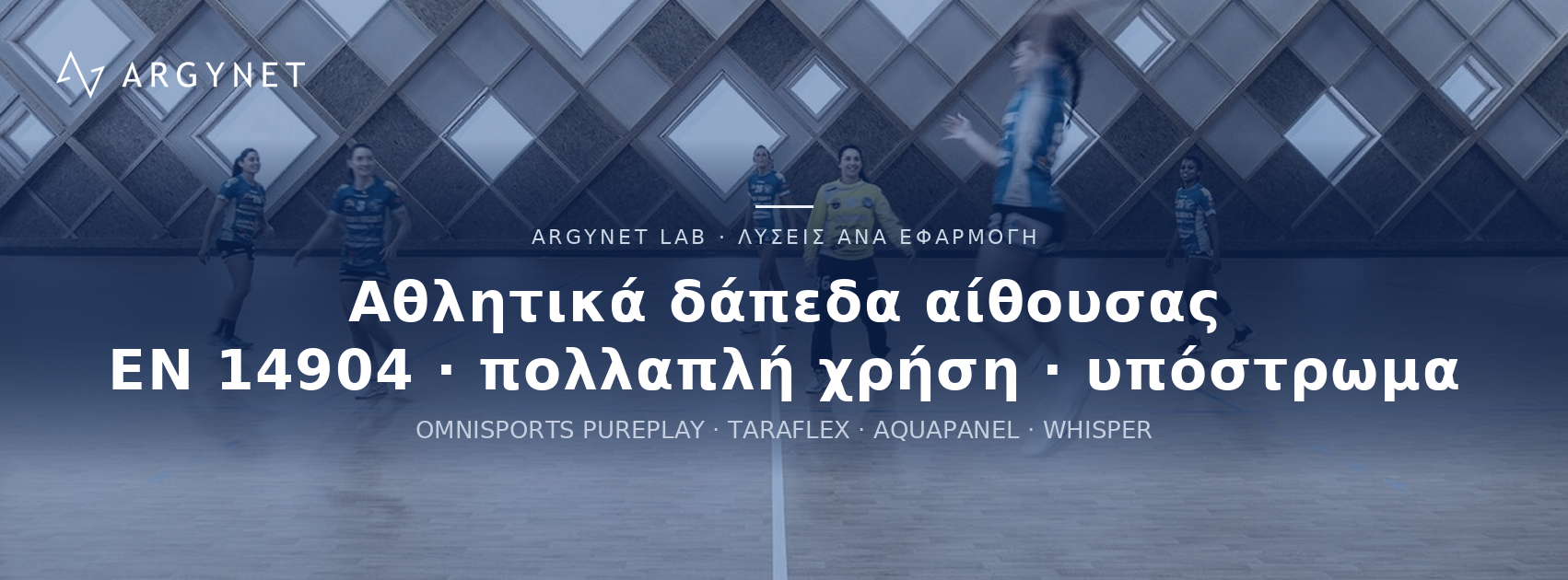
The sports flooring is the only structural element of the building designed to give way. Its performance is not judged by its strength but by how effectively it absorbs the energy of a fall or a jump — and this is measured, classified and certified.
EN 14904: the framework that makes comparison possible
Floors in indoor multi-purpose sports halls are assessed in accordance with the European standard EN 14904. This is not a single figure but a set of parameters that are assessed together:
| Parameter | Test standard | What it describes |
|---|---|---|
| Impact absorption | EN 14808 | How much of the impact energy is absorbed by the floor rather than being returned to the athlete’s joints? |
| Vertical deformation | EN 14809 | How much the surface deflects under load — this determines the sense of stability |
| Ball bounce | EN 12235 | That the ball behaves predictably across the entire surface of the pitch |
| Friction | EN 13036-4 | The range of 80–110, where the sole neither slips nor ‘sticks’ — both of which cause injury |
| Rolling load & survey | EN 1569 · EN 1516 | That the surface is not damaged by wheeled equipment, basketball hoops and spectator stands |
| Wear and tear | EN ISO 5470-1 | Service life of the surface under sports use |
Impact absorption classifies flooring into athlete protection classes: P1 25–34%, P2 35–44%, P3 45–54% and higher. The type and class are stated on the certificate for the specific system and are confirmed by it, not by the commercial description.
Certification to EN 14904 relates to system, not the roll. The same surface material performs differently depending on what lies beneath it — the substrate, the elastic layer, the method of installation. The certificate is required for the specific layered structure to be constructed.
At ARGYNET, we specify the entire stratification and calculate materials per m².
The paradox of multiple use
In Greece, a sports hall is rarely used solely for sport. It hosts examinations, events, meetings and celebrations — with chairs, tables and podiums being moved about and dragged across the floor.
- Sport requires the floor to give way — Shock absorption means elasticity.
- For non-sporting use, the floor must not give way — table legs and platform castors leave a permanent mark on any rubberised surface.
The crucial specification question is how many days a year the hall is not used for sport. If the answer is a two-digit number, the flooring is selected on the basis of both the footprint and the live load — and a protective covering is provided for events.
Hall flooring
| Feature | OMNISPORTS PUREPLAY 9.4 mm | TARAFLEX SPORT M PERFORMANCE 9 mm | OMNISPORTS SPEED 3.45 mm |
|---|---|---|---|
| Construction | 6.5 mm closed-cell foam · wear 0.80 mm | CXP HD foam with D-Max reinforcement | 0.65 mm wear-resistant |
| Impact absorption (EN 14808) | ≥ 35% · P2 | ≥ 25% | ≥ 4% |
| Vertical deformation | P2 | ≤ 3 mm | ≤ 0.8 mm |
| Ball bounce | ≥ 90% | ≥ 90% | ≥ 90% |
| Friction | 80–110 | 80–110 | 80–110 |
| Surface | Top Clean XP | Protecsol · antibacterial efficacy > 99% (ISO 22196) | — |
| Reaction to fire | Cfl-s1 | Cfl-s1 | Cfl-s1 |
| Impact noise reduction | 21 dB | — | 19 dB |
| Roll | 2 × 20.5 m | 1.5 m × up to 26.4 m, cut to order | 2 × 20.5 m · 14 drawings |
| Where it fits | Basketball, volleyball, handball and futsal at amateur and club level | Sports with FIBA, FIVB, EHF, ITTF and IFF approvals; school sports halls | Light-use school sports halls, multi-purpose halls |
The OMNISPORTS SPEED It is not a ‘cheaper’ hall floor — it is in a different category. With a shock absorption rating of ≥ 4 per cent, it does not provide the same level of protection for athletes as a 9 mm floor; it is suitable where the hall is primarily multi-purpose and sport is only played occasionally.
For outdoor sports grounds, athletics tracks and tennis or basketball courts, the EPDM 3 mm It is bonded with PU adhesive to concrete or asphalt with drainage slopes, and is available in four colours.
The moisture content of the substrate determines the method
Roll-out hall flooring is usually bonded over the entire surface — and in ground-floor halls at ground level, moisture in the concrete slab is the most common cause of failure. Manufacturers offer solutions with different performance limits:
| System | Substrate moisture limit |
|---|---|
| TARAFLEX · adhesive installation | RH < 80% or < 4.5% CCM |
| TARAFLEX · Isolsport | < 7% CCM |
| TARAFLEX · Dry-Tex™ | No limit, provided there is no standing water |
| OMNISPORTS · on Tarkolay Sport | Up to 7% CM |
Where the slab is dry, the sequence is primer → self-levelling compound → adhesive: Ceresit R 766 for priming and Ceresit CN 76 (4–50 mm) for levelling. A sports floor surface replicates every irregularity in the substrate — and the ball bounces differently on it.
The cords are not interchangeable
For roll-out flooring, the surface is finished with hot-melt bonding of the joints. There are three distinct families of sealing strips — for vinyl, for linoleum and for sports flooring — and they are not interchangeable. On a sports floor, the joint tape is subjected to the same stresses as the rest of the surface: foot abrasion, falls and machine cleaning. Choosing the wrong one means the joint will be the first to come apart, creating a trip hazard on a surface where people are running.
Around the perimeter, the semi-flexible PVC skirting board forms a seamless corner with the wall, preventing dust from accumulating in the joint.
The walls: the ball hits there too
In a basketball, volleyball or handball hall, the wall cladding is subjected to impacts on a daily basis. AQUAPANEL® cement board is designed for interior walls and suspended ceilings in demanding environments:
- High impact resistance for high-traffic areas.
- Class A1 non-combustible material in accordance with EN 13501-1.
- 100% water resistance and against mould, due to its inorganic composition — which is why it is also suitable for changing rooms, bathrooms and steam rooms, where standard plasterboard is not sufficient.
- Certified indoor air quality according to the IBR Institute.
The acoustics of a sports hall
Large volumes, height, hard surfaces everywhere and loud noises — whistles, shouts, the thud of a ball. Acoustics in a sports hall are not merely a matter of comfort: when the coach cannot be heard, instructions do not get through, and in a space where dozens of children are moving about, this is a safety issue.
The WHISPER® sound-absorbing panels Made from fibre-free polyethylene, they provide an NRC of 1.00 at 50 mm; they are washed and installed as baffles or wall linings where a continuous ceiling is not available. Their positioning is planned in conjunction with the ball’s trajectories, so that the absorbent surface is not subjected to direct impacts. It is Euroclass B: where non-combustible material is required, mineral wool is preferred.
Design series
- Uses of the hall: which sports, at what level, and how many non-sporting events per year.
- Required class according to EN 14904: in accordance with the level of use and federal requirements where applicable.
- Substrate moisture: Measurements to be taken prior to ordering; specifies installation method and substrate.
- Layering: certification relates to the system — the substrate and elastic layer are specified together with the surface.
- Imprint and rolling load: based on the equipment that is actually installed in the room.
- Marking: which sports are marked and in what colour hierarchy.
- Walls, acoustics and wet rooms: impact-resistant cladding, sound-absorbing elements, changing rooms.
Sports Flooring
Substrate & Installation
Masonry, Acoustics & Wet Rooms
Related Solutions from ARGYNET LAB
How many days a year is the hall not used for sport?
Request a Technical Quotation