Waterproofing with polyolefin membrane
Last updated:
POCB polyolefin membrane laid over FIBRANxps with mechanical fastening: telescopic plugs without thermal bridges and a 20-year guarantee.
The system at a glance
Solutions & Applications · Flat Roof Waterproofing
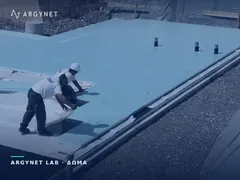
A warm flat roof with a vapour barrier, FIBRANxps thermal insulation and an ESHA Universal waterproofing membrane, mechanically fixed and heat-sealed. No blowtorch is required over the XPS, nor is a second layer needed, and the system remains lightweight. In a single-layer system, however, each seam acts as the waterproofing itself.
What is the POCB membrane?
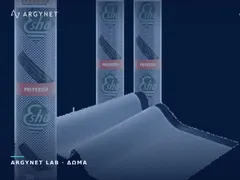
ESHA Universal is manufactured from polyolefin copolymer bitumen (POCB — Polyolefin Copolymer Bitumen). It is based on bitumen, modified with a polyolefin copolymer, with a thickness of 3.2 mm and with polyester and glass fibres as reinforcement. It withstands ultraviolet radiation without the need for surface protection. It retains its flexibility at −30 °C, does not soften up to +120 °C and comes with a 20-year manufacturer’s warranty.
Its composition places it between two product families, and this is where its advantages lie:
| SBS / APP bituminous membrane | Esha Universal · POCB | TPO thermoplastic | PVC | |
|---|---|---|---|---|
| Material database | Modified bitumen | Bitumen + polyolefin copolymer | Polyolefin | Polyvinyl chloride |
| Seam welding | Blowtorch | Hot air | Hot air | Hot air |
| Layers | Usually two | One | One | One |
| Direct contact with XPS | Yes, with a controlled flame | Yes — flame-free | Yes | Not without a separator |
| Over existing bituminous waterproofing | Yes | Yes | With a separator | Not without a separator |
The last line is the least well-known and the most useful in renovation: because it has an asphalt base, the bituminous membrane is compatible with existing asphalt flat roofs. It can be installed on top of them, without the need for removal, provided the substrate is sound.
Layering
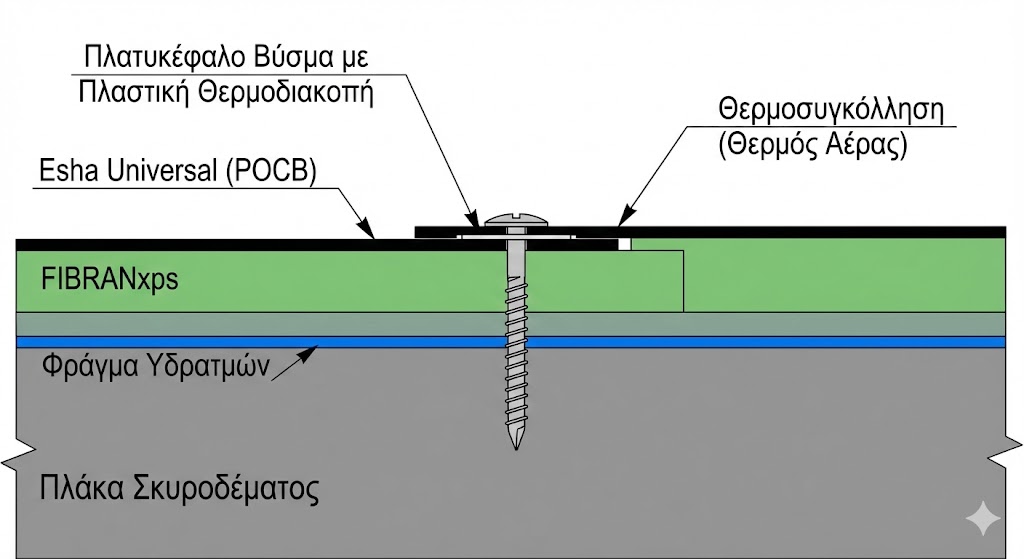
System diagram: ARGYNET LAB
| Layer | Material | Role & key considerations |
|---|---|---|
| Concrete slab | — | Clean, dry, free from weak spots; pull-out strength is tested for plugs |
| Vapour barrier | FIBRANskin BARRIER 2400 | On the warm side, beneath the insulation, with sealed overlaps |
| Thermal insulation | FIBRANxps 300 | Without any cuts in the slab, slopes are created using sloping slabs |
| Mechanical fastening | Flat-headed plug with plastic shank | In the overlap zone, so that it is covered by the next sheet |
| Waterproofing | Esha Universal (POCB) | Single layer · hot-air welded seams |
Mechanical fastening
The plug passes through the entire insulation layer and is anchored to the slab. It is situated in the overlap zone, and the next sheet covers it and is bonded on top of it. This ensures that its head is never left exposed.
The plastic telescopic rod serves two purposes:
- Thermal break: the metal screw does not thermally connect the cold surface to the slab, so no localised thermal bridge is created at each fixing point.
- Membrane protection: when the insulation is compressed by the weight of a person walking on it, the shaft slides round the screw. If it did not slide, the screw head would remain stationary whilst the surface sinks, and would pierce the membrane from below.
The density of fixings is determined by calculating wind pressure, depending on the wind zone, the height of the building and the position on the flat roof. The perimeter and corners require more fixings than the centre, as the wind suction is greater there. In coastal and wind-exposed locations, this calculation must not be omitted.
In a single-layer system, the joint forms the waterproofing. In a double-layer bituminous waterproofing system, an imperfect seam in the first layer is covered by the second. Here, there is no second layer: every metre of seam must be watertight in its own right.
Hot-air welding is quick and clean, but requires the correct combination of temperature, speed and pressure. This varies with ambient temperature and wind conditions. For this reason, work begins with a test seam on site, prior to full-scale application.
Upon completion, each seam is checked along its entire length using a test probe. A point where the seam has not been bonded can then be identified within a few seconds; after the first rainfall, it becomes visible from the ceiling. At ARGYNET, we specify the system and calculate materials and fixings per square metre.
No open flame on the thermal insulation
In bituminous systems laid over XPS, heat welding is carried out using a blowtorch. This requires an experienced contractor crew, as XPS softens at temperatures much lower than that of the flame. With the POCB membrane, no flame is required at all: the seams are welded using hot air, the membrane is mechanically fixed, and the insulation is not subjected to any thermal stress during installation.
This also has a practical implication: work is permitted even in buildings that are in regular use, where the use of open flames is restricted.
Refurbishment on top of an existing bituminous flat roof
As the membrane has an asphalt base, it can be installed over existing asphalt waterproofing without the need for removal. This saves you the hassle of waste disposal, the noise and the number of days the flat roof would otherwise remain exposed. However, there are three conditions:
- Sound substrate: blisters, delamination and loose sections must be removed and repaired first.
- Dry substrate: a new membrane laid over damp old waterproofing traps moisture between them.
- Checking slopes: if water pools on the old flat roof, it will pool on the new one too. Slopes should be corrected beforehand, ideally using sloped thermal insulation, which simultaneously improves energy efficiency.
Penetrations and equipment
On flat roofs with numerous chimneys, air ducts and plant bases, there are more details than meets the eye. Each penetration is dealt with separately:
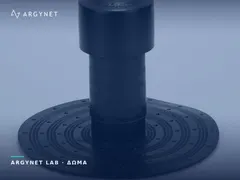
- Collars and pieces made from the same material, heat-sealed to the membrane.
- Vertical extension above the level to which water may rise, with mechanical termination and sealing.
- Equipment bases mounted on independent supports, without loading or perforating the membrane.
The scope of works
- Slab preparation: cleaning, removal of loose material, strength testing for dowels.
- Vapour barrier with sealed overlaps and vertical extensions.
- Thermal insulation in a continuous layer with joints in contact, using sloped panels where cuts are required.
- Laying of a membrane with overlapping joints and fixing at the overlap, including the calculation of wind pressure.
- Test joint on site.
- Heat-weld all seams using hot air.
- Details on penetrations, parapets and guttering.
- Check seams with a probe along their entire length.
When to choose
| If the requirement is… | System |
|---|---|
| Lightweight construction, flame-free, refurbishment on asphalt | Single-layer POCB membrane — this solution |
| Ventilated bituminous system, on a sloped slab | Flat roof with existing slopes |
| Slopes and thermal insulation in a single layer | Sloped thermal insulation |
| A walkable, visible, seamless finished surface | Polyurea |
| Maximum service life of the waterproofing | Inverted roof |
System Materials
Related Solutions from ARGYNET LAB
Is there a wind pressure calculation for the fixings — and a test seam before installation?
Request a Technical Quotation