Hospitality, Travel & Leisure – Kitchens & laundry rooms
Last updated:
Resin or vinyl in the commercial kitchen, two slip-resistance scales, laundry, staff showers, wet-area ceilings and joints. An ARGYNET LAB guide.
The system at a glance
- GRANIT SAFE.T | Non-slip vinyl flooring for wet areas
- iQ GRANIT | Homogeneous vinyl flooring for hospitals and schools
- PRIMO PREMIUM | Homogeneous vinyl flooring with a subtle textured finish
- ACCZENT EXCELLENCE COMPACT+ | Heterogeneous vinyl roll for heavy footfall
- Tarkett vinyl joint tapes | Heat-sealing of 4 mm joints
- SINROC 22 Flooring | Self-levelling compound epoxy flooring 1–2 & 3–4 mm
- SINMAST RM 22 | Epoxy protective coating for food-grade areas
- SINMAST RM 32 | High-strength epoxy protective coating
- SINMAST S2 Wet on Wet | Epoxy primer for damp substrates
- AMF THERMATEX® Aquatec 19mm
- AQUAPANEL® Indoor cement board
- CERESIT CL 51 Express 1-K | Brush-on waterproofing membrane
- CERESIT CS 25 | Silicone Sanitary Sealant
Solutions & Applications · Hospitality · Back of House
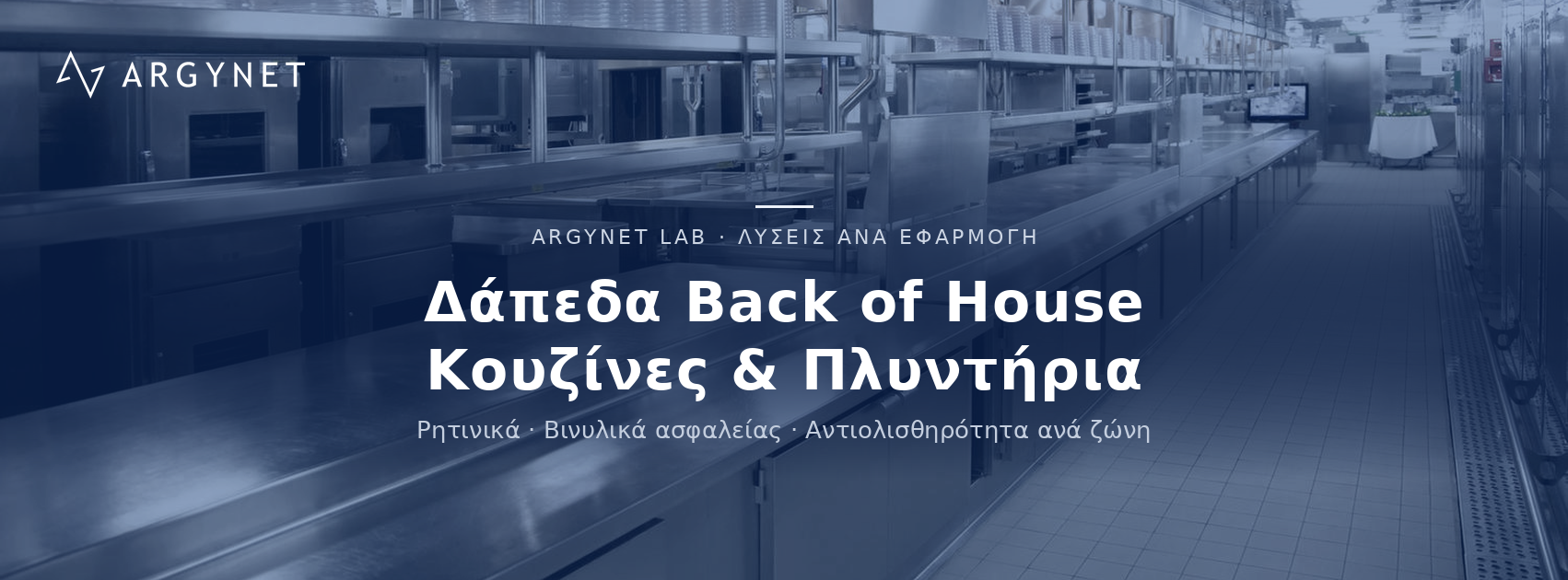
Guests never set foot in the hotel kitchen or laundry — yet that is where it is decided whether breakfast comes out on time and whether the sheets reach the rooms clean. Back-of-house floors are not designed to impress; they are designed for staff safety, for the health inspection and for years of operation without interruption.
Three spaces, three logics
"Wet area" does not mean the same thing in the kitchen, the laundry and the changing rooms. What falls on the floor, who walks on it and how it is cleaned all change:
| Space | Main stress | Approach |
|---|---|---|
| Commercial kitchen | Grease, water, hot washdowns, trolleys, standing, health inspection | Seamless SINROC 22 / SINMAST resin system or GRANIT SAFE.T safety vinyl, heat-welded with coving up the wall |
| Laundry & linen room | Water from machines, heavy linen trolleys, heat, lint | iQ GRANIT, PRIMO PREMIUM or ACCZENT EXCELLENCE COMPACT+ · GRANIT SAFE.T around the machines |
| Staff changing rooms & showers | Bare feet, soap, constant moisture | GRANIT SAFE.T — Class C for bare feet, watertight with coving up the wall |
Slip resistance: two scales, not one
The most common mistake in specifying wet areas is to ask for a "slip-resistant floor" without saying for whom. There are two independent scales:
| Scale | What it measures | Where it applies |
|---|---|---|
| R9 to R13 | Slip with work shoes, on an inclined ramp with oil | Kitchens, laundries, workspaces with footwear |
| Class A, B, C (bare feet) | Slip with bare feet, in soapy water — EN 16165 Annex A | Showers, changing rooms, pool surrounds |
An R11 floor is not necessarily safe for bare feet, and a Class C floor does not automatically mean R11. GRANIT SAFE.T covers both scales: Class C for bare feet, with R10 or R11 on order, thanks to particles embedded through the full thickness of the material (EN 13845) — slip resistance does not wear away.
Every grade of slip resistance above the one required has a cost: a rougher surface holds more dirt and needs mechanical cleaning. The grade is set per zone — higher at the cooking line and the dishwashing area, lower in preparation and storage — not uniformly for the whole space. Occupational safety guidelines for commercial kitchens usually call for R11 and above, depending on production volume; the requirement is written into the design, not into the invoice.
The commercial kitchen: resin or vinyl?
Both solutions deliver a continuous, watertight, hygienically acceptable surface. They differ in what they withstand and in how the staff who stand on them for ten hours feel:
| Criterion | Resin system (SINROC 22 / SINMAST) | Safety vinyl (GRANIT SAFE.T) |
|---|---|---|
| Joints | None — seamless poured surface | Heat-welded with 4 mm rod, seam ≥ 400 N/50 mm |
| Slip resistance | R10 or R11 with quartz sand broadcast | R10/R11 and Class C for bare feet, through the full thickness |
| Mechanical stress | Impact > 20 Nm (Class III), trolleys, forklifts | Class 34/43, residual indentation 0.02 mm |
| Cleaning | Steam cleaning too | Safety Clean XP surface, wet mechanical cleaning |
| Standing | Hard surface | Warmer and more resilient underfoot |
| Installation | Specialist applicator, concrete moisture control | Laid in 2 × 25 m rolls, fast handover |
Resin is the answer where there is very hot water, steam, heavy trolleys or a goods-receiving zone. Safety vinyl is the answer where staff comfort and speed of renovation matter — especially in a hotel that renovates its kitchen in the gap between two seasons. The resin solution is covered in detail on the page on hygienic floors for food facilities.
A kitchen floor almost always fails at the same points: at floor drains, at drainage channels and where it meets the wall. With vinyl, the drains must have a clamping flange for the floor covering and the coving up the wall is heat-welded. With resin, the cove at the base of the wall is formed before the coating. This detail is designed with the kitchen equipment supplier, before the units go in.
Laundry & linen room
A hotel laundry is a small industrial unit inside the building: heavy machines with vibration, water from connections and drains, linen trolleys full of wet textiles, heat from the dryers and lint that settles everywhere.
- Homogeneous vinyl: iQ GRANIT and PRIMO PREMIUM have colour and pattern through their full 2 mm thickness, wet-area watertightness (EN 13553) with coving up the wall and residual indentation of 0.03 mm or less — heavy trolleys leave no marks.
- Wax-free: the iQ PUR surface of iQ GRANIT is restored by dry buffing; the Premium Pro surface of PRIMO PREMIUM resists stains and chemicals.
- Around the machines: GRANIT SAFE.T in the loading and unloading zone, where water falls on the floor. It coordinates in colour with iQ GRANIT.
- Machine bases: high-speed industrial washers sit on their own bases, according to their manufacturer's instructions — not on the finished floor.
- Linen room: a dry space with trolleys — ACCZENT EXCELLENCE COMPACT+ delivers a 0.80 mm wear layer, R10 and 93 designs, when the space is also seen by the public.
Staff changing rooms & showers
In changing rooms, staff walk barefoot in soapy water — the worst slip condition there is. Here the critical value is the bare-foot class, not the R rating. GRANIT SAFE.T with Class C (EN 16165 Annex A) also covers the shower zone, with the floor coved up the wall without a joint.
On shower walls, AQUAPANEL® Indoor cement board — inorganic, non-combustible A1, mould-resistant — together with the liquid-applied waterproofing CERESIT CL 51 provides a substrate for tiles that is unaffected by constant moisture.
Ceilings, walls & joints
- Ceiling: AMF THERMATEX® Aquatec withstands 100% relative humidity, with Class A sound absorption (αw 0.90) and ISO 3 Clean Room certification — for kitchens, laundries and changing rooms.
- Walls: AQUAPANEL® Indoor in drywall construction, where plasterboard is not enough.
- Joints: CERESIT CS 25 is a sanitary silicone sealant for perimeter joints between worktops, units and walls.
- Vinyl seams: 4 mm welding rods in the design of each floor — essential for watertightness and for coving up the wall.
Design sequence
- Zones: cooking line, dishwashing, preparation, goods receiving, laundry, linen room, changing rooms.
- Slip resistance per zone: R rating for footwear, class for bare feet.
- System: resin or vinyl, depending on water temperature, trolleys and time available for works.
- Drainage: drains, channels and falls before the floor finish.
- Subfloor: concrete moisture and strength, repairs.
- Perimeter: coving up the wall, joint sealing, wet-area walls and ceiling.
Wet-Area Vinyl Flooring
Resin Flooring
Walls, Ceilings & Waterproofing
Related ARGYNET LAB Solutions
Send us the back-of-house floor plan with its zones — we will propose a system and slip-resistance grade for each space.
Request a Technical Quote