Installation of a root-barrier membrane
Last updated:
The vertical barrier does not kill the root — it diverts it. Trench depth, 2–5 cm overhang, overlaps and the side facing the roots.
The system at a glance
Solutions & Applications · Root Protection
A vertical barrier does not kill the root — it diverts it. And because the root is constantly searching, the entire success of the project hinges on two factors: how deep the barrier reaches and how high it extends.
Material technology
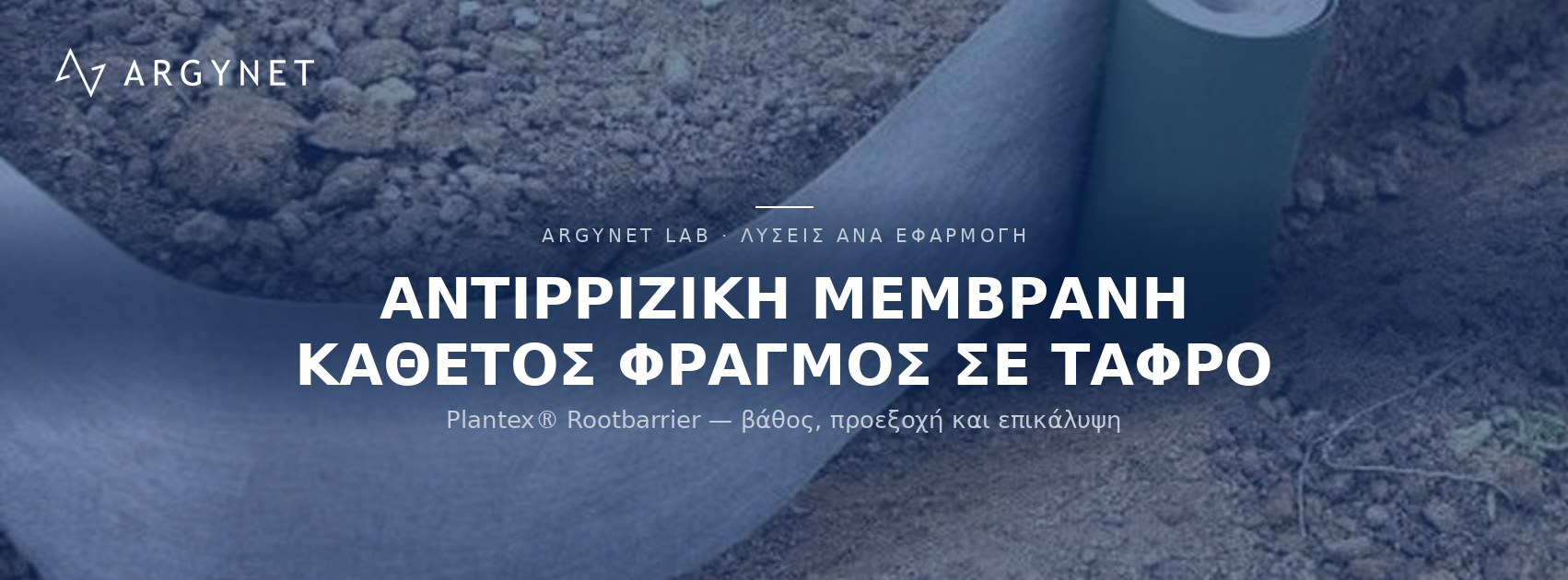
Plantex® Rootbarrier is a non-woven geotextile made from heat-bonded polypropylene fibres, with a special waterproof coating on one side. Unlike simple HDPE membranes, DuPont’s technology offers:
- High mechanical strength: resistance to static puncture up to 3,500 N in accordance with EN ISO 12236.
- Chemical inertness: it is not affected by the pH of the soil and does not release toxic substances.
- Flexibility: adapts to trenches, corners and around pipework without breaking.
The difference compared to a rigid HDPE sheet is practical: in a trench with uneven walls, the flexible material follows the profile without leaving any gaps behind it — and the gap behind the barrier is precisely the path the root seeks.
Fields of application
In accordance with international practice in urban green space management, a vertical barrier is required in:
- Utility networks: sewerage and water supply pipes, fibre-optic cables.
- Structural protection: building foundations, retaining walls, swimming pools.
- Roadworks and pavements: prevention of slab heave and asphalt cracking.
- Restriction on invasive species: bamboo (Phyllostachys), firethorn and other rhizomatous plants.
The barrier does not stop the root; it directs it downwards. It is this misconception that determines the depth of excavation. A shallow barrier offers no less protection — it offers none at all: the root goes down, passes beneath the edge and re-emerges on the other side, often with greater vigour because it has already grown.
The same applies upwards. The 2–5 cm overhang above the final level is not a finishing detail: without it, the root simply grows over the barrier. In the international literature, this is referred to as ‘over-the-top growth’ and is the most common way in which a correctly installed barrier is rendered ineffective.
At ARGYNET, we specify depth and spread based on the type and age of the planting, and calculate materials per running metre.
Installation methodology
A. Substrate preparation
- Excavation: digging a trench to a depth appropriate to the type of tree. International practice recommends 60 to 100 cm for most urban applications.
- Clearing: removal of sharp objects — stones, metal, debris — from the trench walls, which could damage the membrane during backfilling.
B. Installation — vertical application
- Orientation: the green, coated side always faces the plant’s roots. It is a one-way material — the coating is the side that deflects.
- Position on the wall: the membrane is installed perpendicular to the wall of the trench that abuts the structure to be protected.
- Overhang: 2–5 cm above the final ground level, to prevent growth over the barrier.
C. Joints & overlaps
- Overlap: where two sheets meet, at least 50 cm.
- Bonding: for maximum security — particularly on bamboo — use the special double-sided Plantex® Tape adhesive tape, after cleaning the surface of any dust.
D. Backfilling
- Gradual backfilling: the trench is filled in layers, with compacted soil or stabilised material at the base.
- Do not place heavy machinery directly on top of the membrane before it has been adequately covered.
Standards & certifications
| Parameter | Price / Standard |
|---|---|
| Resistance to root penetration | Certified in accordance with CEN/TS 14416 |
| Tensile strength | 22 kN/m in accordance with EN ISO 10319 |
| Resistance to static puncture | 3,500 N in accordance with EN ISO 12236 |
| Expected service life | Over 20 years under normal ground conditions |
Maintenance & precautions
- Avoid herbicides: contact with strong chemical herbicides may damage the coating.
- Distance from the trunk: the membrane must not ‘strangle’ the tree. It should be positioned at a safe distance from the root ball, ideally around the perimeter of the planted area.
- Position marking: the route of the barrier is shown on the project drawing. Any future excavation work that is unaware of its location will cut through it.
This guide has been compiled in accordance with the specifications of DuPont™ Plantex®, the guidelines of international organisations such as the ISA (International Society of Arboriculture) and European standards for the protection of infrastructure from root systems.
Root Barrier Protection
Supplementary Geosynthetics for the Trench
A vertical barrier is rarely used on its own. Within the same excavation, there are three further requirements, each with its own specific material:
- Separation: where the trench is backfilled with material of a different grain size to the natural ground, a geotextile prevents mixing and future settlement of the surface.
- Drainage: the barrier is impermeable. If water collects in the trench, a localised pool forms, which forces the roots to seek a way out — and undermines the pavement. A perforated pipe with a filter solves both problems.
- Surface reinforcement: where the barrier passes beneath a pavement or road surface, the backfilled trench is always the weakest zone. A biaxial geogrid in the base course limits differential settlement that causes cracking of the surface directly above the excavation.
Related Solutions from ARGYNET LAB
How deep does the barrier go — and how high does it extend?
Request a Technical Quotation