
Root protection: when to use a physical barrier, and when a chemical inhibitor?
Last updated:
Roots do not break through the waterproofing — they find a way through it. A physical barrier or a chemical inhibitor: they fail in opposite ways, and that is w
The system at a glance
- PLANTEX® ROOTBARRIER | Root-resistant membrane
- FIBRANskin AQUASHIELD | Root-resistant membrane
- ESHAGUM ANTIROOT B5 -10°C | Bituminous root-resistant membrane
- ESHAROOFCOAT No10 ANTIROOT B5 | Anti-root protection for planters
- ESHADIEN ANTIROOT | Bituminous root-resistant membrane
- ESHAPROTECT | HDPE protective membrane
- FIBRANfilter SF32 | PP geotextile
Solutions & Applications · Geosynthetics
A root does not force its way through the waterproofing — it finds a way through it. It seeks out moisture and penetrates every imperfection, joint or overlap. That is why the two available technologies differ not only in cost: they fail in completely different ways, and the choice depends on which part of the project you have the least confidence in.
Three technologies, three approaches
| Physical barrier | Chemical inhibitor in sheet form | Chemical inhibitor for liquid-applied coating | |
|---|---|---|---|
| What is | A sheet that roots cannot penetrate mechanically — non-woven PP or synthetic membrane | Bituminous waterproofing membrane with a root-resistant component in the mixture | Liquid elastomeric solution with a root-resistant component, applied with a roller or brush |
| Mechanism | Impermeable structure; the root strikes it and is deflected | The component repels the root before it grows to the surface | Single-piece, seamless — the layer is, by definition, continuous |
| Relation to waterproofing | A separate layer above the waterproofing | One sheet — two functions in one product | The same material — waterproofs and protects |
| Where it falls short | At joints, penetrations and edges | Where the component is not available — cross-sections, details, repairs using standard materials | In short: insufficient application means virtually no protection in certain areas |
| Where it excels | Large, continuous surfaces | Flat roofs with fewer details — one layer instead of two | Complex geometries: planters, corners, small areas where the sheet is not cut cleanly |
The third column precisely resolves the problem posed by the first two. In a planter, a planted corner or a surface with numerous penetrations, failure does not originate from the surface itself but from the multitude of cuts and joints. A liquid-applied coating has no seams — and where there is no seam, there is no point of entry.
The two solutions fail in opposite ways — which is why the choice is not a matter of budget.
A physical barrier is impermeable across its surface but vulnerable at its joints: a root will never penetrate the sheet, but will travel in search of the first point where two sheets merely overlap without being bonded together. The chemical inhibitor is uniform across the entire surface and at the overlaps, but is lost the moment the layer is continued using a standard bituminous membrane on the parapets or during a repair.
In practice: a barrier when you trust the welding contractor crew and the surface is uniform; a sheet-based barrier when you want fewer layers on a flat roof with simple geometry; A liquid-applied coating where there are more details than surface area. At ARGYNET, we specify the entire layering and calculate materials per m².
What does ‘anti-root’ mean as a specification?
The term is not a trade name. Resistance to root penetration is tested by planting aggressive plant species on top of the specimen and monitoring it over a long period — two or four years, depending on the protocol.
The requirement in the tender is specific:
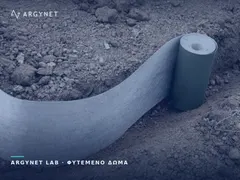
- For geosynthetic barriers: declaration of suitability as a root barrier in accordance with CEN/TS 14416. PLANTEX® ROOTBARRIER has certified root resistance in accordance with the standard, with test results showing no penetration.
- For waterproofing membranes: documentation of resistance to root penetration for the specific sheet — not for the range in general.
- In all cases: the certificate relates to the product code to be supplied. Two membranes from the same product family, one with and one without a root-resistant membrane, appear identical on the roll.
Materials in this category
| Product | Technology | Its unique selling point |
|---|---|---|
| PLANTEX® ROOTBARRIER | Physical barrier | Non-woven fabric made from 100% continuous PP filaments; CEN/TS 14416 certified, no perforations |
| FIBRANskin AQUASHIELD | Physical barrier | Dual function in a single layer: waterproofing and decoupling; flexibility down to −40 °C, tensile strength 650 N/50 mm |
| ESHAGUM ANTIROOT B5 −10 °C | Chemist on call | Plastomeric bituminous membrane with Preventol® B5 — part of a complete green flat roof system |
| ESHAROOFCOAT No10 ANTIROOT B5 | Liquid-applied coating | Hyper-elastomeric solution with Preventol® B5 — for planters and seamless composite surfaces |
| ESHAPROTECT | Mechanical armouring | HDPE 1.0 mm · a sliding sheet that absorbs movements in the overlying layer |
The second line is worth noting. Decoupling is a function that usually requires a separate sheet: it allows the waterproofing and the underlying slab to move independently, so that thermal and structural movements are not transmitted as stresses. When combined with single-layer waterproofing, an entire layer is removed from the build-up — and with it, the potential points of failure.
Where do green roofs actually go wrong?
The flat roof surface is rarely the problem. Roots tend to penetrate at the same five points:
- Extension at parapets: the root barrier rises up the vertical surfaces and terminates above the level of the planting substrate. If it stops lower down, the root will simply grow over it.
- Gutters and drain outlets: a point of persistent damp — precisely what the root is seeking. This requires a specialised component and reinforcement, not simply cutting and gluing.
- Pipe penetrations and equipment bases: any hole in the waterproofing is an open invitation.
- Expansion joints: these move; the root barrier must follow the movement without opening up.
- Post-completion repairs: a patch using a bituminous membrane locally negates the protection — and is perhaps the most common of all.
When is the barrier one-way?
Certain species are not treated with a growth inhibitor. Rhizomatous and invasive species — bamboo, poplar, certain creeping shrubs — develop horizontal rhizomes with mechanical strength that cannot be chemically prevented. In such cases, a physical barrier is required, often a vertical one, to direct the root downwards rather than allowing it to spread laterally.
The same applies at boundaries: a flowerbed adjacent to paving, a tree near a basement wall, a planter in contact with insulation. In such cases, the barrier does not protect the waterproofing — it protects the structure.
The role in stratification
| Layer | Role | Point to note |
|---|---|---|
| Waterproofing | Flat roof waterproofing | If it is of the anti-root type, delete the following line |
| Root barrier | Protection of waterproofing against roots | Adhesive-bonded membranes, expansion in vertical planes |
| Protection sheet | Structural reinforcement during construction | The heavy load comes from the rubble and wheelbarrows, not from the plants |
| Drainage | Drainage of excess water | Stagnant water forces the roots to seek a way out to the sides |
| Geotextile filter | Planting substrate retention | The key requirement here is a large pore opening — zero water retention |
| Substrate & planting | The visible part | Depth determines the size of the roots that will develop |
The fourth point is the least obvious and perhaps the most important: good drainage is part of the root control strategy. A root in a well-drained substrate has no reason to search; a root above standing water grows horizontally in search of oxygen and finds the joints.
Design series
- Planting types: extensive green roof or intensive green roof with shrubs and trees — determines whether the retainer is adequate.
- Substrate depth: determines the size and strength of the root system.
- Architectural choice: integrated root-resistant waterproofing or waterproofing plus a separate barrier.
- Details before materials: parapets, guttering, penetrations, joints — that is where the project is judged.
- Drainage: dimensioned so that there is no standing water above the waterproofing.
- Maintenance protocol: a written instruction stating that all repairs must be carried out using root-barrier material.
Physical Barriers
Chemical Inhibitors
Roof Protection & Drainage for Flat Roofs
Related Solutions from ARGYNET LAB
Which part of the project do you have the least confidence in — the joints or the maintenance?
Request a Technical Quotation