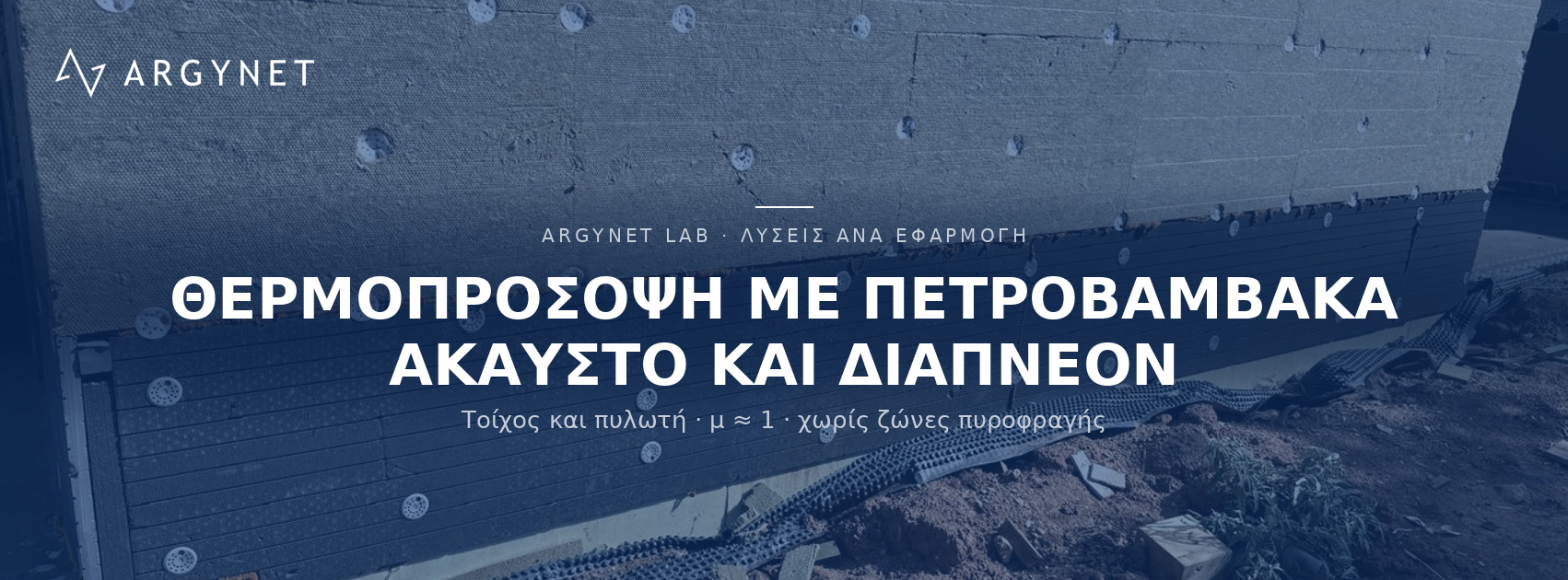
External thermal insulation of walls and pilotis using stone wool
Last updated:
Stone wool is not selected for the l: it is non-combustible and has a vapour permeability of m ≈ 1. However, this vapour permeability is lost if the render is a
The system at a glance
- FIBRANgeo BP-ETICS | Stone wool for External Thermal Insulation
- FIBRANgeo BP ETICSplus | Stone wool for External Thermal Insulation
- CERESIT CT 180 MW STRONG FIX | Stone wool adhesive mortar
- CERESIT CT 190 MW FLEX | Adhesive mortar and base coat for stone wool
- KLIMAS LTX10 | Thermal Insulation Plugs
- FIBRAN CAPS | ETICS Plug Covers
- CERESIT CT 327 | Glass fibre mesh
- FIBRAN ALU Aluminium Installation Guide
- CERESIT CT 174 | Silicone-based – Silicate rendering
- CERESIT CT 74 | Silicone-based finishing render
- CERESIT CT 54 | Silicate Paint
- CERESIT CT 49 | Nano-silicone-based paint
- CERESIT CT 16 | Acrylic primer
- FIBRANxps ETICS GF | External Wall Insulation
- FIBRANgeo B-001 | Stone wool for masonry, roofing and dry construction
Solutions & Applications · Thermal Insulation & Fire Protection
Stone wool is not selected for external wall insulation on the basis of its thermal performance — in this respect, all insulating materials are comparable. It is chosen for two properties that the others lack entirely: it is non-combustible and is practically permeable to water vapour.
Vapour permeability in figures
The water vapour diffusion resistance factor μ indicates how many times more difficult it is for water vapour to pass through a material compared with still air. Comparing the three ETICS insulation systems is not a matter of degree — it is a matter of order of magnitude:
| Material | Coefficient μ | What does this mean? |
|---|---|---|
| Stone wool | μ ≈ 1 | In practice, the same resistance as still air — the wall continues to breathe |
| XPS | μ ≈ 50 | Fifty times greater resistance |
| EPS | μ ≈ 30–70 | Similar order of magnitude |
This is why stone wool is the recommended choice for older buildings, where the masonry contains natural moisture — from rising damp, from past leaks, or from the very construction moisture accumulated over decades. A system with a vapour barrier on the external side traps this moisture within the structure; a breathable system allows it to escape.
The vapour permeability you pay for in the insulation is lost in the render. It is the mistake that negates the whole rationale behind the choice and is never apparent on site.
The system breathes only as much as its most impermeable component allows. Acrylic render or acrylic paint applied over stone wool creates a barrier precisely where vapour should be able to escape. The result is worse than a coherent EPS system, because moisture now accumulates at the interface between the insulation and the render.
Where stone wool is selected, the final render and paint must be silicone-based, silicone-silicate or silicate-based — never acrylic. At ARGYNET, we specify the entire system and calculate materials per m².
Fire safety is not just a classification — it is also a matter of detail
The A1 fire rating is the obvious selling point. What is less obvious is what you save on construction costs.
In systems using foam insulation, regulations require fire barriers — horizontal strips of non-combustible material at specified levels and around the perimeter of openings — to prevent the fire from spreading vertically up the façade. Each zone is a distinct detail: different material, different thickness, different adhesive, and the point where two systems meet.
With stone wool covering the entire façade, these joints are no longer required. One material, one detail, no points where two systems need to meet properly. The difference in material cost is partly offset by the reduction in labour and the fewer potential points of failure.
It is also a mandatory requirement in buildings where regulations so stipulate: high-rise buildings, schools and hospitals, and buildings situated near property boundaries or in woodland areas.
The entrance hall: the building’s largest thermal bridge
The roof of the entrance hall is not a roof — it is the floor of the flats above, with the outside air beneath it. It is the surface with the highest performance per square metre in the entire building, and the first-floor tenant is immediately aware of this.
- The insulation continues onto the beam. A layer that stops at the edge of the slab leaves the beam exposed — that is, the coldest point, where damp and mould appear in the corner of the flat.
- Continuing with the elevation. The insulation of the entrance hall and the façade must meet without any gap; otherwise, the corner remains a thermal bridge despite the double cladding.
- Fire safety in a semi-open space: vehicles are parked in the entrance hall. The fire load is real and is located directly beneath residential units.
- Exposure: moisture, temperature fluctuations and, in coastal projects, salt spray — fixings shall be selected with corrosion protection.
What you need to know before submitting a quotation
- Weight: stone wool is significantly heavier than foam materials. Mechanical fixing is not optional and the number of fixings is determined by calculation — the substrate must be capable of withstanding the load.
- Protection against rain: slabs that have become damp prior to the application of the base coat must be allowed to dry completely. Applying render to damp stone wool traps moisture precisely where the choice of material was intended to avoid it.
- Working time: cutting and fitting are more labour-intensive than with foam products; this should be taken into account in the planning stage.
- The base course remains XPS, regardless of the choice for the rest of the façade — there, the criterion is moisture, not fire safety.
Acoustic consistency
Sound insulation is not a marketing gimmick — it stems from the structure. The open-cell fibrous structure of stone wool dampens the sound energy entering its mass, whilst a rigid, closed-cell foam material behaves like a spring between two masses and can cause resonance at certain frequencies.
On a façade facing a busy road, the difference is noticeable to the occupant — and this is a selling point in a residential refurbishment, where energy efficiency is an abstract concept but noise is a daily reality.
ETICS stone wool
Bonding, Fixing & Reinforcement
Breathable Finishes — Never Acrylics
Base Course & Supplementary Materials
Related Solutions from ARGYNET LAB
Does your render allow the building to breathe — or does it negate the benefits of stone wool?
Request a Technical Quotation