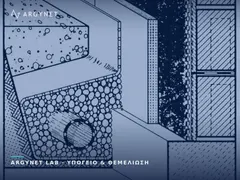

Waterproofing of Earth-Sheltered Houses
Last updated:
In an earth-sheltered house, any fault remains buried beneath the soil. Fully bonded membrane, radon barrier, joints and drainage with proven durability.
The system at a glance
- ESHADIEN SBS -20 | Elastomeric bituminous membrane
- ESHASTICK P-P | Self-adhesive elastomeric bituminous waterproofing membrane
- ESHAFIN SBS -10 | Elastomeric bituminous membrane
- ESHAHYDROBENT | Water-swelling bentonite cord - waterstop
- ESHASEALER No1 | Asphalt joint sealant
- ESHAPROTECT | HDPE protective membrane
- PNW Protection | Geotextile for the Mechanical Protection of Geomembranes
- DANODREN H15 PLUS | HDPE dimpled drainage membrane with geotextile
- MAXISTUD GEO | 20mm HDPE dimpled drainage membrane with geotextile
- Nophadrain ND 4+1h | HIPS Composite Dimpled Drainage Membrane
- GEODRAIN PLUS | Drainage pipe with geotextile
Solutions & Applications · Waterproofing of Underground and Earth-sheltered Structures
Earth-sheltered houses — residential properties, hotels, and facilities situated below ground level — are a growing trend in Greek architecture, thanks to the sloping topography of many areas, the relevant legislation and lower energy requirements. However, they share one common feature: when the waterproofing fails, repairs are extremely costly and time-consuming, as the problem lies beneath the soil, a concrete slab or the floor. The system must be installed correctly from the outset.
What Constitutes an Earth-Sheltered House
In accordance with Law 4067/2012 (Government Gazette A-79/9 April 2012), An earth-sheltered house is a building or part of a building constructed below ground level, with the ground fully restored to its original form, and having only one visible façade. Its primary use may be residential, hospitality or as a workspace.
- Integration into the landscape: the structure follows the natural slope of the ground rather than disrupting it.
- Bioclimatic performance: the thermal inertia of the ground reduces energy requirements for heating and cooling.
- Protection: physical shielding against extreme weather conditions.
- Favourable town-planning regulations in certain cases, depending on the use and location.
The 3 Key Factors for Success
At ARGYNET, before we recommend materials, we always examine the same three factors that determine whether an earth-sheltered house's basement waterproofing system will last for decades or require repair within the first few years.
- A composite system, not a single material: the waterproofing must ensure functionality even in the event of unforeseen localised damage — a fully bonded membrane, not a single line of defence.
- Proven drainage capacity: depending on the surface load and the depth of the structure. A simple, unfiltered dimpled drainage membrane is not sufficient for an earth-sheltered house of primary use — a composite sheet with a filter and documented compressive strength for the load it will bear is required.
- Radon barrier: radon is a colourless, odourless gas resulting from the natural decay of radium in the subsoil and is associated with respiratory diseases. In an earth-sheltered house used for primary purposes, the waterproofing layer must also act as a radon barrier — such as the ESHAFIN bituminous membrane in the version with internal aluminium reinforcement.
Membrane or Liquid-Applied Coating?
The choice between a membrane and a liquid-applied coating is not a question of cost but of long-term reliability:
| Waterproofing Membranes | Liquid-applied Coating Materials |
|---|---|
| Consistent, industrially manufactured waterproofing thickness | Uneven thickness — depends on the installer |
| They incorporate reinforcement that increases mechanical strength | The reinforcement is installed separately — risk of incomplete impregnation |
| Long-term waterproofing, with no particular weather-related restrictions on application | Short-term, with strict temperature/humidity restrictions |
| Speed of installation, specialist contractor crews | Slow curing; specific curing times are required |
Bituminous or Plastic Membrane?
| Bituminous Membranes | Plastic Membranes |
|---|---|
| Manufactured thickness, from 2.5 mm per layer | Thinner sheet, usually up to 1.5 mm |
| Full adhesion to the substrate — any failure remains localised | Adhesion mainly at the seams — increased risk of leakage spreading |
| A large number of trained installation contractor crews in Greece | A limited number of specialist contractor crews |
| A variety of application methods (cold-applied, self-adhesive, hot-applied) | Limited methods, specialised equipment |
Composite Drainage Sheet or Traditional Gravel?
| Aggregates (Gravel) | Composite Drainage Sheets |
|---|---|
| Variable drainage capacity (natural product) | Consistent, predictable performance over time (manufactured) |
| Heavy-duty material, minimum thickness 100 mm, additional space | Lightweight sheet 6–25 mm, minimum dead load |
| Requires separate geotextile for the top and bottom | Composite product — filters already bonded to the core |
| Risk of damage to the waterproofing layer during installation | Protects the waterproofing layer |
The criterion for selecting the sheet is its compressive strength in relation to the load it will bear. On the roof of the earth-sheltered house, beneath backfill and planting, a composite sheet with an HIPS core, such as Nophadrain ND 4+1h, provides 600 kPa. On vertical walls, where the load consists of lateral soil pressure, HDPE membranes with a pre-bonded filter are sufficient — DANODREN H15 PLUS with 180 kN/m² or MAXISTUD GEO with 150 kPa.
The most common mistake in earth-sheltered houses is not the choice of inferior materials, but the design of the waterproofing as a single layer rather than an integrated system: a fully bonded waterproofing membrane, mechanical protection, drainage of proven effectiveness and the sealing of construction joints with a water-swelling cord.
At ARGYNET, we specify the entire waterproofing system for an earth-sheltered house’s basement and calculate materials per m².
Standard Layering
- Adhesion primer for concrete, for full bonding of the membrane.
- Sealing of construction joints with a water-swelling bentonite cord prior to concreting the wall — it cannot be inserted afterwards.
- Main bituminous membrane, fully bonded or self-adhesive depending on the pitch and geometry; where a radon barrier is required, available in a version with aluminium reinforcement.
- Mechanical protection of the waterproofing prior to backfilling or concreting a slab on ground.
- Composite drainage sheet with filter: for walls, HDPE with geotextile; for green roofs, a HIPS core with high compressive strength.
- Drainage pipe with geotextile at the base, for the collection and discharge of water.
- Backfilling with full restoration of the natural ground.
Waterproofing & Joints
Protection & Drainage
Related Solutions from ARGYNET LAB
Are you designing an earth-sheltered house and would you like a comprehensive waterproofing proposal?
Request a Technical Quotation