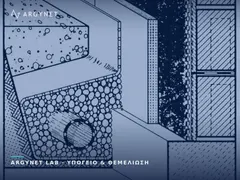

Waterproofing of a construction joint in a waterproof basement envelope
Last updated:
The waterproofed basin does not leak from the concrete but from the joints. Cord, tape or injection tube — and the 80 mm overlap that determines the result.
The system at a glance
- ESHAHYDROBENT | Water-swelling bentonite cord - waterstop
- PVC Waterstop | Waterstop tapes for concrete joints
- VANDEX UNIMORTAR 1 | Waterproofing and repair mortar
- TECNOSEAL 96 | Polyurethane Joint Sealing Compound
- ESHAPOLYSEAL 1K | Elastomeric polyurethane joint sealant
- ESHAPRIMER 21 | Single-component polyurethane primer
- ESHASEALER No1 | Asphalt joint sealant
- CERESIT CL 152 | Waterproofing membrane
- CERESIT CR 166 Flexible 2-K | Flexible cementitious waterproofing compound
- ESHAGUM APP -10 | Polymer-modified bituminous membrane
- ESHACOAT 6S | Elastomeric bituminous emulsion
- DANODREN H15 PLUS | HDPE dimpled drainage membrane with geotextile
- MAXISTUD GEO | 20mm HDPE dimpled drainage membrane with geotextile
- GEODRAIN PLUS | Drainage pipe with geotextile
- ESHAPROTECT | HDPE protective membrane
Solutions & Applications · Joint Sealing & Waterstops
A watertight basin does not leak from the concrete — it leaks from the joints. Properly designed and compacted concrete of sufficient thickness is practically impermeable. Every basement leak can be traced to one of four points: a construction joint, a penetration, a crack or a nail hole.
A joint is not a flaw — it is a design choice
No basement is concreted in a single pour. The joint between the plinth and the wall, and the joints between successive layers of concrete, are a given. The question is not whether they will exist, but where they will be located and how they will be waterproofed.
The difference from a crack is crucial: a crack is random and cannot be anticipated. A joint is known in advance — and is therefore the only potential leak point that can be addressed preventatively and with precision.
Three sealing technologies
| Water-swelling cord | Waterstop tape | Injection pipe | |
|---|---|---|---|
| How it works | It swells when exposed to moisture and seals the joint by exerting pressure on its walls | Flexible PVC-P tape embedded in concrete — a mechanical barrier that extends the water’s path | It remains empty; if a leak occurs, resin is injected subsequently |
| Installation | On the surface of the hardened concrete, prior to the next concreting | Inside the formwork, secured to the reinforcement prior to concreting | In the joint, with ends in accessible injection boxes |
| Requirement for accuracy | Low — simple, quick, without interfering with the formwork | High — requires fixing to the reinforcement and welding of joints; displacement during concreting renders the system ineffective | The positioning of the boxes is of moderate to critical importance |
| Advantage | No welding, no joints — works even on uneven surfaces | Functions independently of the presence of water; also covers moving joints | Allows for repairs without excavation |
| Role | First line of defence | At the forefront of high-water-level projects | Safety measure — repair without excavation |
The three are not mutually exclusive. In a project with a high water table or in a structure where future access is impossible — a basement beneath neighbouring buildings, a tank, or a lift shaft — the combination of a cord and an injection pipe is the sensible choice: the former provides a watertight seal, whilst the latter allows for rectification should anything go wrong.
The water-swelling cord works by exerting pressure — and that very pressure can cause the concrete to crack. If the cord is placed too close to the face of the wall, the expansion force does not seal the joint; it peels away the facing. The result is a joint that leaks more badly than if nothing had been inserted at all.
The rule is simple and is often disregarded: sufficient concrete cover around the perimeter of the cord, typically in the region of eight centimetres, with the exact value to be taken from the product’s technical data sheet. In thin walls, this also determines the position of the reinforcement.
At ARGYNET, we specify the joint as a design detail — position, type, covering — and calculate materials per running metre.
Preparation of the joint
- Removal of cement laitance: the loose layer on the surface of hardened concrete is removed by water jetting, shot blasting or wire brushing. A cord bonded to laitance has no substrate.
- Cleaning: dust, formwork oils and residues must be completely removed.
- Moisture control: the surface must be dry at the time of application — otherwise the cord will start to swell prematurely.
- Positioning: in the centre of the thickness, with the required overlap on both sides.
Fitting the cord
- Continuous run: the strip is not interrupted. At joints, the ends must overlap by approximately 5 cm; they must never simply be placed side by side — a gap of one centimetre is an open passage.
- Full contact: fixing with a suitable adhesive or mechanically, at close intervals. A strip that comes away from and is dragged along by the fresh concrete does not provide any waterproofing.
- Protection against premature expansion: if rain falls before the next concreting operation, the cord expands and has exhausted its capacity. On exposed building sites, covering is required, or a type with delayed expansion should be selected.
- Concreting: thorough compaction around the joint area to ensure no voids remain — the vibrator must not come into contact with the string.
ESHAHYDROBENT is a water-swelling bentonite cord with a swelling capacity of over 400 per cent. It seals the joint from the inside, without any bonding or joints — it is activated by the very water it is designed to stop.
The remainder of the waterproof basement envelope
The joint is the critical point, but not the only one. The system is completed by three further layers:
| Level | Role | Material |
|---|---|---|
| Repairs & drains | Levelling, filling cavities, curved floor-to-wall joints | Waterproofing repair mortar |
| External waterproofing | Continuous barrier on the side facing the ground | Bituminous membrane, liquid-applied coating or cementitious |
| Protection & drainage | Waterproofing reinforcement and relief of hydrostatic pressure | Dimpled drainage membrane with filter, perforated pipe |
The third line is the one that protects the work of the first. The best joint is the one that is never put to the test: proper perimeter drainage means that no column of water forms on the wall, so the joint is not subjected to hydrostatic pressure. Drainage is not merely supplementary to the waterstop — it is the prerequisite that allows it to function effectively.
The remaining three leakage paths
- Penetrations: each pipe passing through the wall must be sealed individually — using a water-swelling ring or a specialised fitting, never with simple foam.
- Holes for dowels: these must be sealed with non-shrink mortar to their full depth, not just superficially on both sides.
- Cracks: these are controlled by means of reinforcement and the spacing of construction joints; where they do occur, they are treated by injection.
The expansion joint is another issue
A construction joint is fixed: two successive concrete pours that simply must not leak into one another. An expansion joint is the exact opposite — the only part of the structure designed to move, undergoing thousands of cycles of contraction and expansion over its lifetime.
These technologies are not interchangeable. A water-swelling cord in a moving joint will fail; an elastic sealant in a stop joint is superfluous. For movement joints, the requirement is a certified movement class in accordance with EN 15651-1 and elastic recovery after each cycle.
Two details that determine the service life
- Filling cord: expanded closed-cell polyethylene, placed at the bottom of the joint before the sealant is applied. It is not merely a cost-saving filler — it controls the depth of the sealing layer and, crucially, prevents adhesion to the substrate. Sealant bonded on all three sides cannot deform freely and will tear within the first few cycles.
- Joint priming: without the correct primer, even the best polyurethane sealant will delaminate during the first winter. It is the cheapest material in the joint and the first to be omitted.
Design series
- Water table: seepage water or constant hydrostatic pressure — determines the type and number of defence lines.
- Concrete placement plan: where the joints will be located, in what order and in which stress zones.
- Wall thickness and position of reinforcement: these determine whether there is the required cover for a water-swelling cord.
- Accessibility for future repairs: where this is not provided, an injection pipe shall be incorporated from the outset.
- External waterproofing: selection of materials based, amongst other criteria, on the adhesion of the subsequent layer.
- Drainage: perimeter drain and, where required, a retention trench.
Construction Joint
Expansion and Movement Joints
External Wall Waterproofing
Protection & Pressure Relief
Related Solutions from ARGYNET LAB
Is there the required concrete cover around the cord?
Request a Technical Quotation