Drainage system for building components
Last updated:
Waterproofing keeps water out; drainage ensures it never builds up under pressure. Perimeter drain or retention trench — and sometimes both.
The system at a glance
- DRAIN E 400 | Dimpled drainage membrane
- GEODRAIN | Perforated drainage pipe
- GEODRAIN PLUS | Drainage pipe with geotextile
- MAXISTUD GEO | 20mm HDPE dimpled drainage membrane with geotextile
- MAXISTUD F | 20mm HDPE dimpled drainage membrane
- DANODREN H15 PLUS | HDPE dimpled drainage membrane with geotextile
- SNW Superior | Thermally Treated Filtration Geotextile
- NW Standard | Non-woven polypropylene geotextile
- ESHACOAT 6S | Elastomeric bituminous emulsion
- ESHAGUM APP -10 | Polymer-modified bituminous membrane
- CERESIT CR 166 Flexible 2-K | Flexible cementitious waterproofing compound
- ESHAHYDROBENT | Water-swelling bentonite cord - waterstop
Solutions & Applications · Drainage
Drainage and waterproofing are two separate disciplines that are often confused. Waterproofing keeps water out; drainage ensures that it never builds up under pressure. A building with excellent waterproofing and no drainage works — until the first flaw appears. A building with proper drainage never faces this test.
Why water in the ground is a structural problem
The presence of water in the ground around a building does not merely cause damp:
- Soil weakening: saturated soil loses its shear strength and bearing capacity.
- Hydrostatic pressure: a column of water against a wall exerts a horizontal load that was not taken into account in the design.
- Buoyancy: in a high-water table, pressure is also exerted upwards on the basement slab.
- Wet-dry cycles: these place stress on the concrete and accelerate the corrosion of the reinforcement.
There is no such thing as ‘the’ perimeter drainage. There are two different systems, and they are systematically confused.
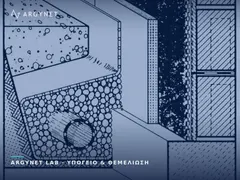
The perimeter drain is installed at the level of the footing, in contact with the foundation. It collects the water running down from the wall’s dimpled drainage membrane and directs it away from the building. This is the standard arrangement for any basement.
The cut-off trench is positioned at a distance from the structure — typically around 2.0 m — and is intended to intercept the underground flow before it reaches the building. It is used when water is coming from a specific direction: a building on a slope, an upstream aquifer or a neighbouring excavation.
The two are not interchangeable. A project on a slope requires both. At ARGYNET, we design the layout based on the topography and the water table, and calculate materials per running metre.
When which
| Condition | Perimeter drain | Retaining trench |
|---|---|---|
| Position | At the plinth level, tangent | At a distance, upstream of the structure |
| What is supplied | Water running down the wall | Subsurface flow directed towards the building |
| Level ground | Essential | Usually unnecessary |
| Building on slopes | Essential | Essential — otherwise the perimeter will be overloaded |
| High water-retention capacity | Essential, with buoyancy control | As appropriate |
Layering from the inside out
- Clean concrete and reinforced concrete for foundations.
- Waterproofing layer on the wall — bituminous emulsion, bituminous membrane or cementitious material, depending on the water conditions.
- HDPE dimpled drainage membrane with conical protrusions, to protect the waterproofing and act as a vertical drainage channel.
- Filter geotextile — either pre-bonded to the membrane or separate.
- Gravel around the perimeter and a perforated drainpipe at the base, sloping towards the collection point.
- Layered backfill — gravel and soil.
Waterproofing: three technologies, three conditions
| Material | Typology | When to choose |
|---|---|---|
| ESHACOAT 6S | Elastomeric bituminous emulsion | Liquid-applied coating for complex geometries and details — seamless |
| ESHAGUM APP -10 | Plasticised bituminous membrane | Large continuous surfaces where a documented layer thickness is required |
| CERESIT CR 166 | 2-component elastomeric cementitious compound | Where the next layer needs to adhere — renders, tiles, cementitious materials |
The third line highlights the practical difference that determines the choice: almost nothing adheres to bituminous material. Where the wall is to be rendered or clad — typically in the section above ground level — a cementitious product is the only option.
The dimpled drainage membrane: with or without a filter
| Product | Typology | When |
|---|---|---|
| DRAIN E 400 | HDPE 7.5 mm, without filter | Backfill consisting of coarse-grained, clean material containing no fine particles liable to migration |
| MAXISTUD F | HDPE 20 mm, without filter | Larger channel — higher flow rate or greater wall height |
| DANODREN H15 PLUS | HDPE with geotextile | Fine-grained backfill — that is, the typical case of excavated material |
The criterion is not the depth but the grain size distribution of the backfill. When the trench is backfilled with the excavated material — which is the norm — there are fine particles, and without a filter these will end up in the channel and the pipe. Failure occurs years later, and rectification requires excavation around the entire perimeter.
The perforated conduit
The pipe is installed around the perimeter of the foundation and connected to the drainage pipe, with a sufficient gradient to prevent backflow. Two rules that must not be breached:
- A layer of gravel around the pipe — facilitates water ingress and removes soil from the holes.
- Geotextile around the perimeter of the trench with good hydraulic properties — prevents fine particles and roots from blocking the holes.
GEODRAIN PLUS comes with the geotextile already fitted to the pipe: one less step on site and no risk of it being overlooked.
Inspection chambers are also provided at the corners. A system that cannot be inspected cannot be maintained — and a blocked perimeter drain gives no indication of a problem until damp appears in the basement.
Design series
- Water table and topography: these determine whether only a perimeter drain is required, or whether a retention trench is also required.
- Water conditions in the wall: seepage water or constant hydrostatic pressure — this affects the choice of waterproofing material.
- Grade analysis of backfill: this determines whether the membrane requires a filter.
- Wall height and flow rate: these determine the thickness of the channel — 7.5 or 20 mm.
- Drainage routes and gradients: where the water ends up, at what gradient, and via which drains.
- Compatibility with the next layer: if the wall is to be rendered, the waterproofing product should be selected on the basis of adhesion.
Dimpled Drainage Membranes
Perforated Pipes & Geotextiles
Wall Waterproofing
Categories & Related Solutions
Does the water come from above or from the side? The answer changes the entire project.
Request a Technical Quotation