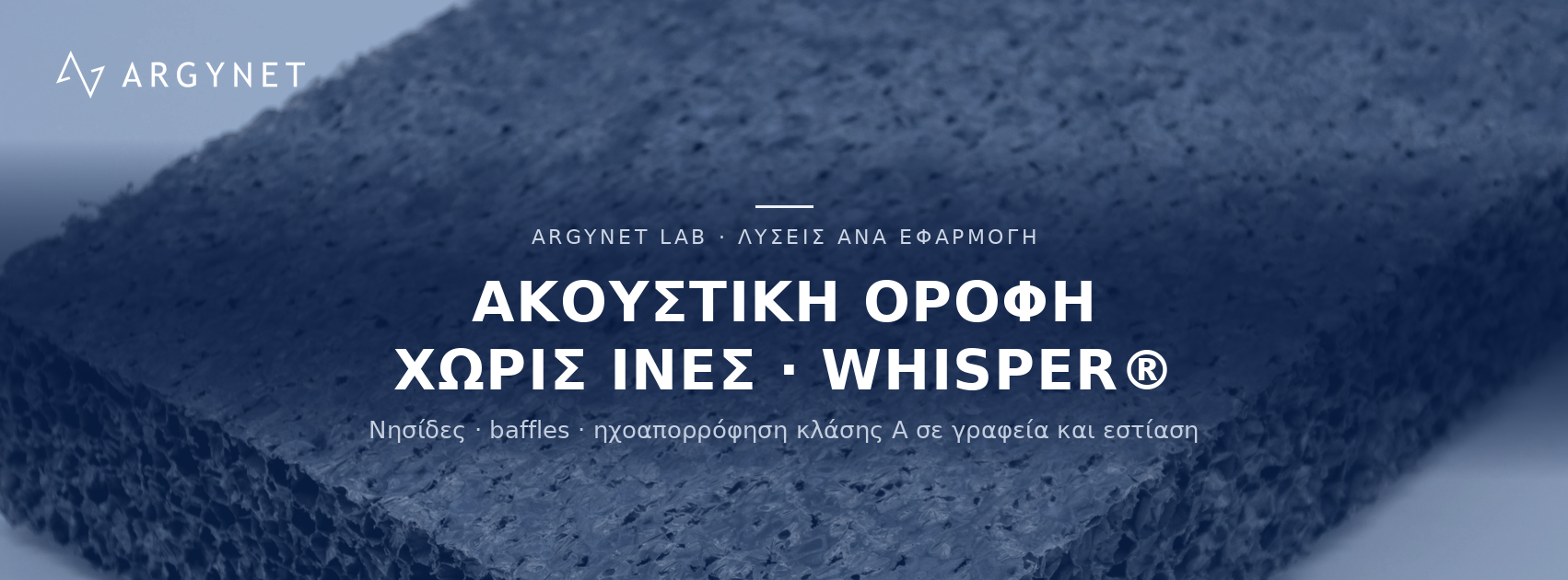
Fibre-free acoustic ceiling with WHISPER®: Class A sound absorption in offices and catering establishments
Last updated:
It explains when the problem is reverberation rather than sound insulation, how WHISPER® is installed in islands or baffles, and why it is resistant to water, d
The system at a glance
- WHISPER® | Sound-absorbing polyethylene panels
- CLEANEO® AKUSTIK UFF 8/12/50 R 12.5 | Perforated plasterboard
- AMF THERMATEX® Alpha Colour Black
- HERADESIGN® Fine 15mm
- FIBRANgeo B-050 | Stone wool for masonry, roofing and dry construction
- ISOLFON BARRIER | Sound insulation for plasterboard
- ISOLFON ReRub | Floor and wall sound insulation
- KNAUF SILENTBOARD DFR 12.5mm | High-Performance Sound-Insulating Plasterboard
Solutions & Applications · Acoustics for Offices & Catering Establishments
In modern open-plan offices and restaurants, the problem is not noise from the neighbouring space — it is the reverberation within the space itself. Glass façades, plasterboard, hard floors and exposed beams reflect everything. The ceiling is the largest unobstructed surface and, usually, the only one available for acoustic treatment — and with WHISPER®, the treatment can be carried out without a suspended ceiling and without fibres.
Why the roof is the right place to intervene
In an open-plan space or a dining area, there are few walls, and those that exist are often glass partitions. The floor is covered by furniture. The ceiling remains unobstructed, exposed and directly opposite the source of the noise — people’s voices. A sound-absorbing ceiling reduces reverberation time, improves speech intelligibility and lowers the overall noise level, as people stop unconsciously raising their voices. It’s the ‘busy restaurant effect’: the more people are talking, the louder everyone speaks.
WHISPER®: the fibre-free sound-absorbing material
SEE’s WHISPER® panels are a sound-absorbing material made from high-performance polyethylene foam, with a honeycomb-type interlocking cell structure. The material remains acoustically ‘soft’ and traps sound without any fibres. The manufacturer’s specifications:
| Property | Price |
|---|---|
| Sound absorption 50 mm | NRC 1.00 · αw 1.00 — Class A according to EN ISO 11654 (Class A at 40 mm) |
| Airflow resistance | 2,785,000 Pa·s/m³ — the index that explains absorption |
| Weight | ≈ 1.25 kg/m² at 50 mm — minimum load on the suspension |
| Fibres & emissions | Fibre-free, formaldehyde-free, low VOC; particle emissions 0.02 mg/m² |
| Water & chemicals | Washable · resistant to chlorine, peroxides and quaternary ammonium compounds |
| Fungi | Does not support development |
| Operating temperature | −40 °C to +80 °C |
| Dimensions & colours | 120×240 cm · 20 to 50 mm · white, grey, charcoal |
The real ‘weapon’: water, dust and chemicals
WHISPER® is a non-polar, low-surface-energy plastic: water and dust do not adhere to it. The manufacturer substantiates this with a ‘once-in-50-years’ storm simulation — water at 3 l/min, wind speeds up to 16 m/s — after which the material retains 100 per cent of its acoustic performance, without the need for a vapour barrier or protective lining.
This is precisely why it excels where fibrous materials fall short: kitchens, swimming pools, changing rooms, food processing plants — and in any space where fibre dust is undesirable, such as offices with sensitive equipment or catering areas.
Four installation methods
| Format | How to install | When to choose it |
|---|---|---|
| Roof raft | Horizontal panels suspended beneath the slab, with a clear void above | Offices and catering — where architectural aesthetics matter and headroom is limited |
| Sound baffle | Vertical panels in rows | High-ceilinged spaces: sports halls, industrial premises, swimming pools — absorb sound from both sides |
| Directly onto the slab | Adhesive bonding or mechanical fastening with screws and large-diameter washers | Low clear height, technical areas, plant rooms |
| Wall cladding | In a document or directly | Additionally, where the ceiling is insufficient or the echo comes from opposite walls |
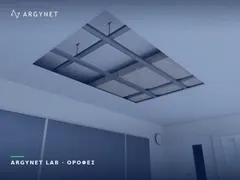
It is rarely necessary to cover the entire ceiling. With the correct zoning — islands above tables or workstations — partial coverage delivers excellent results at a lower cost, whilst leaving areas free for lighting, air conditioning and sprinklers.
Sound absorption is not sound insulation. The figures show this clearly: at 50 mm, WHISPER® achieves Class A sound absorption, but the sound reduction of the material on its own is Rw 13.8 dB. It will make your space quiet from the inside; it will not prevent sound from passing into the neighbouring office. First, determine which of the two problems you have — often it is both.
The coverage ratio and thickness are selected on the basis of the target reverberation time (T60). For interior spaces, the WHISPER® FR version is used; the reaction to fire is confirmed by the manufacturer’s current data sheet for each application.
Correct installation
- Plan view first: positions of islands in relation to light fittings, vents, sprinkler heads and detectors — the panels must not obstruct the flow of air or the coverage of the sprinklers.
- Suspension: wire ropes or cables with suitable fittings; the low weight allows for lightweight suspension and large spans.
- Cutting: on site using a blade or saw — no fibre dust, no gloves or masks required.
- Colour: anthracite ‘blends into’ dark ceilings and allows the lighting to take centre stage; white reflects more light.
- Cleaning: with water — ideal for kitchens and areas with greasy vapours.
And the other sound-absorbing solutions
| Solution | When do we prefer it? |
|---|---|
| WHISPER® in islands or baffles | No suspended ceiling, no fibres, resistant to moisture or chemicals, for refurbishment with an exposed ceiling |
| 60×60 mineral fibre boards | When access to the entire void is required for electrical and mechanical services and sprinklers |
| Perforated plasterboard | A single, monolithic or curved roof with no visible battens |
| Wood wool | Natural texture, impact resistance — schools, sports halls |
If the noise comes from an adjacent room or from the floor above, the problem is sound insulation: mass, filling the void with stone wool, a viscoelastic membrane and, for impact noise, an anti-vibration layer on the floor.
The most cost-effective acoustic intervention is one carried out before the premises are opened. Afterwards, any intervention must be carried out whilst the shop or offices are closed or in operation. A light fitting included in the lighting design costs less than one added because customers have complained.
At ARGYNET, we analyse the acoustic requirements of your space, recommend the thickness and method of installation, and calculate the materials required per square metre.
Sound absorption
If the problem is sound insulation
Related Solutions from ARGYNET LAB
Is your space ‘buzzing’? We measure, specify and calculate.
Request a Technical Quotation