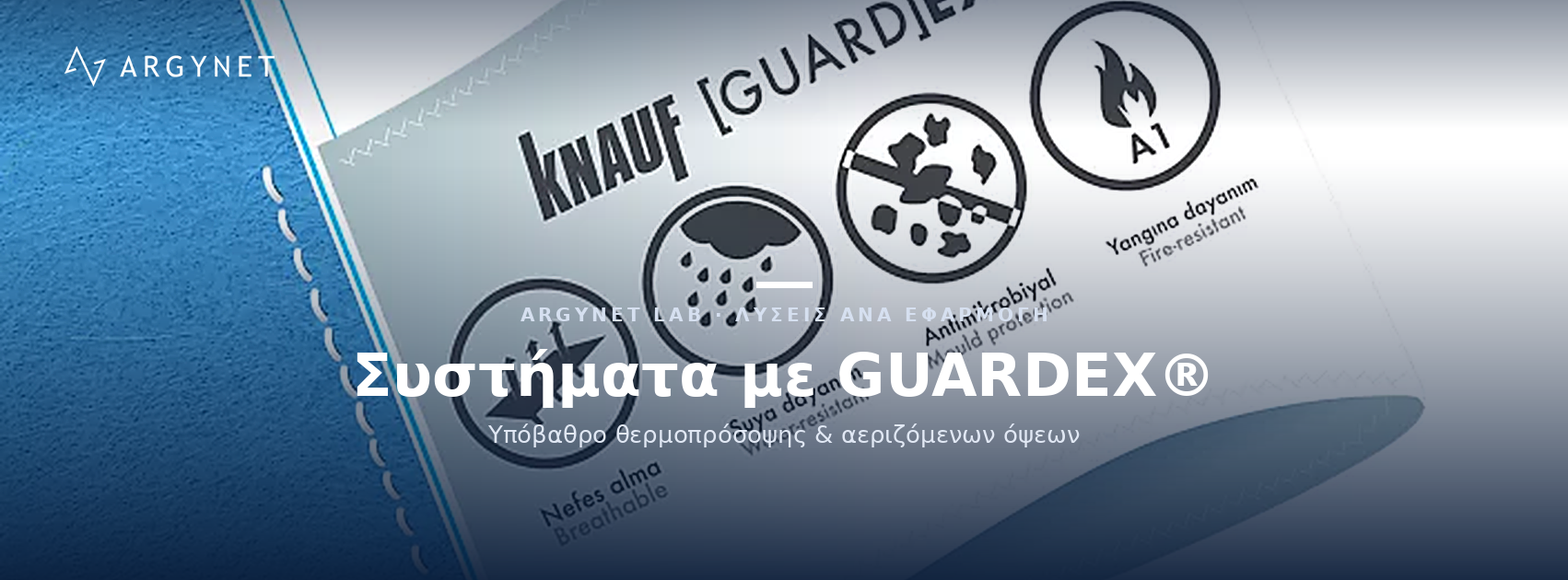
Systems featuring GUARDEX®: the glass-mat board that encloses the framework and supports the external wall insulation
Last updated:
When to use glass-mat board and when to use cement board in the building envelope, which insulation to use for each façade zone, and the three points that are o
The system at a glance
- GUARDEX® 12.5mm glass-mat board
- GLASROC-X glass-mat board
- FIBRANgeo BP-ETICS | Stone wool for External Thermal Insulation
- FIBRANxps ETICS GF | External Wall Insulation
- GRAFIT EPS-80 | Graphite-based
- KNAUF AQUAPANEL Outdoor 12.5mm | Cement board for external use
- Knauf CW stud 50x50x0.6 mm
- Knauf UW track 50x40x0.6 mm
- Naturboard 032 | ECOSE mineral wool boards
Solutions & Applications · Facades & Dry Construction
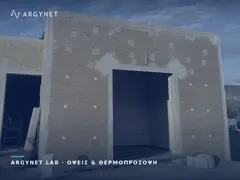
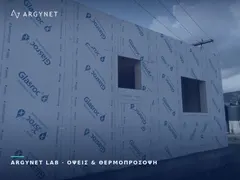
The lightweight framework is completed in a few days; the external wall insulation requires good weather and a contractor crew. In the interim, the building envelope remains exposed. GUARDEX® is the glass-mat board that encloses the framework from the outside, protects the building until the external wall insulation is installed and acts as its substrate — non-combustible, moisture-resistant and free from paper that could go mouldy.
What is GUARDEX®?
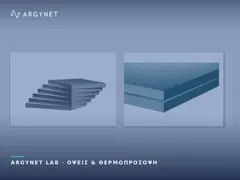
Plasterboard with a core of special plaster and glass fibre mesh instead of paper on both sides. It contains no organic paper, so it does not harbour mould and does not delaminate when wet — the key difference from a moisture-resistant plasterboard for internal use.
| Feature | GUARDEX® 12.5 mm |
|---|---|
| Type in accordance with EN 15283-1+A1 | GM-FH1R |
| Reaction to fire (EN 13501-1) | A1 — non-combustible |
| Water absorption | H1 (≤ 2,5%) |
| Dimensions | 1,200 × 2,400 mm and 1,200 × 2,000 mm |
| Surface mass | ~12 kg/m² (34.5 kg per 2,400 mm slab) |
| End type | AK |
| A never-ending exhibition | Up to 12 months, with sealed joints |
The code GM-FH1R is read letter by letter: GM glass fibre, F improved core cohesion at high temperature, H1 reduced water absorption, R increased strength. This is the identification required by an external cladding specification — not the colour of the panel.
Three applications to the building envelope
| Application | The structure | What are the benefits? |
|---|---|---|
| External walls of lightweight construction buildings | Steel or timber frame · GUARDEX® on the exterior · external wall insulation | A multi-storey building envelope that can be completed quickly and is suitable for ETICS without an intermediate layer |
| Filling walls between concrete slabs | Framework between slabs; mineral wool in the framework; GUARDEX®; ETICS applied in front of the slabs | Lighter and quicker to install than masonry, continuous thermal insulation in front of the facades |
| Ventilated façade substrate | Framework · GUARDEX® as a wind barrier · sub-frame · panels, stone or timber | Non-combustible, moisture-resistant sheet behind the ventilated cavity |
The greatest benefit lies in load-bearing walls. The external wall insulation runs continuously in front of the slab faces, where a thermal bridge would normally occur in conventional masonry. The mineral wool within the frame enhances thermal and acoustic performance without increasing the external thickness of the wall.
Glass-mat board or cement board?
Three types of external-use slabs perform similar functions but are based on different principles:
| Slab | Nature | Massa | When is it preferable? |
|---|---|---|---|
| GUARDEX® | GM-FH1R glass-mat board · A1 | ~12 kg/m² | ETICS and ventilated façade substrates, lightweight cladding, extensive on-site display |
| GLASROC-X | Cellulose-free glass-mat board | ~11.2 kg/m² | External cladding and temporary protection of the structural frame |
| AQUAPANEL® Outdoor | Cement board · A1 · 100% water-resistant | 16 kg/m² | Render applied directly onto the slab, areas subject to continuous wetting, curved facades (radius up to 1 m) |
H2 or DFH2 moisture-resistant plasterboard is not an external board. ‘Green’ refers to reduced water absorption in bathrooms, not resistance to rain and sunlight: the surface paper cannot withstand weeks of exposure on a building site. For the external sheet, glass-mat board or cement board is explicitly required.
GUARDEX® is a substrate — its performance is judged by the insulation
The slab encloses and protects the framework; the thermal and fire performance of the façade is determined by the system installed on top of it. The choice of insulation is made on a zone-by-zone basis for the façade:
| Insulation | λD | Reaction to fire | Where it fits |
|---|---|---|---|
| FIBRANgeo BP-ETICS | 0.035 W/(m·K) | A1 | Multi-storey buildings where a non-combustible system and sound insulation are required; CS(10) ≥ 30 kPa |
| GRAFIT EPS-80 | 0.030 W/(m·K) | E | Maximum thermal performance with the thinnest possible thickness |
| FIBRANxps ETICS GF | 0.033–0.036 W/(m·K) | E | Base course and plinth, where the façade is exposed to water from the ground; WL(T) 0.7–1.5 per cent |
A common configuration: XPS in the base zone, stone wool or graphite-coated EPS on the rest of the façade, over the same GUARDEX®. For an exposed concrete finish, the Ceretherm Visage Concrete system provides the texture without the weight of concrete.
Three points that are often overlooked
- Screws for external use: with enhanced corrosion protection, suitable for concrete slabs — not standard internal plasterboard screws. A rusty screw behind the external wall insulation will show up as a blemish on the finished surface.
- The 12-month exposure period requires sealed joints: using the jointing materials specified by the manufacturer. Open joints mean water ingress into the structure, however good the slab may be.
- The cladding system comprises the following: GUARDEX® is the substrate. The thermal insulation, reinforcement and render — or the framework of the ventilated façade — form a certified assembly and are specified together.
Design series
- Shell type: lightweight load-bearing frame, infill wall between slabs or ventilated façade substrate.
- Framework: CW/UW metal or timber, with stud spacing as per the system sheet.
- Frame filling: mineral wool for the thermal and acoustic performance of the wall.
- Outer sheet: GUARDEX®, or AQUAPANEL® Outdoor, where the render is applied directly to the board.
- Exposure time: the number of months the building envelope will remain unfinished — this determines the sealing of the joints.
- Insulation by zone: non-combustible requirement, base zone, U-value target.
- Finish: thin-coat ETICS render, exposed concrete finish or ventilated cladding.
Exterior Cladding Panels
Framework & Infill
Thermal insulation on GUARDEX®
Related Solutions from ARGYNET LAB
How many months will the building shell remain exposed before the external wall insulation is installed?
Request a Technical Quotation