What is the correct thickness of insulation for my area? (Climate Zones)
Last updated:
Correct thickness = climate zone × λ coefficient. Umax per KENAK zone, comparison of insulation materials and the altitude rule.
The system at a glance
- FIBRANgeo BP-ETICS | Stone wool for External Thermal Insulation
- FIBRANxps ETICS GF | External Wall Insulation
- GRAFIT EPS-80 | Graphite-based
- TERMOPOR EPS-80 | White
- CERESIT CT 82 | Adhesive mortar & Base coat
- CERESIT CT 327 | Glass fibre mesh
- KLIMAS LTX10 | Thermal Insulation Plugs
- FIBRAN ALU Aluminium Installation Guide
- FIBRAN CAPS | ETICS Plug Covers
Solutions & Applications · Decision-making tool
The correct thickness is not a case of ‘the thicker, the better’. It is determined by two factors multiplied together: the project’s climate zone and the material’s λ-value. Changing one alters the other.
Step 1 — The climate zone
According to KENAK, Greece is divided into four zones, from the warmest (A) to the coldest (D). The regulation specifies a maximum heat transfer coefficient (Umax) for walls in each zone — the lower the value, the more insulation is required.
| Zone | Indicative areas | Umax wall | Indicative thickness* |
|---|---|---|---|
| A | Crete, the Aegean Islands, the Dodecanese, the southern Peloponnese | ≤ 0.55 W/m²K | ~5 cm |
| B | Attica, the Cyclades, the Ionian Islands, and a large part of the southern mainland | ≤ 0.45 W/m²K | ~6 cm |
| C | Central and Western Macedonia (lowlands), Thessaly, Epirus | ≤ 0.40 W/m²K | ~7 cm |
| D | Western Macedonia, Florina, Grevena, mountainous areas | ≤ 0.35 W/m²K | ~8 cm |
*Indicative thickness for insulation with λ ≈ 0.035 W/mK. The exact thickness is determined by the energy assessment in accordance with TOTE 20701-1.
Altitude takes precedence over the map. Areas at an altitude of over 500 m are automatically classified in the next colder zone — the mountainous region of Attica is not zone B but zone C.
This is where the most common error in the quantity take-off occurs: the prefecture is shown in the table, but the altitude is not. A project in Parnitha or the mountains of Arcadia is specified using the thickness applicable to the lowland zone and therefore fails the energy assessment.
At ARGYNET, we confirm the zone and altitude before providing a quotation, and we calculate materials per m².
Step 2 — The material: why the ‘l’ determines the thickness
Two materials with different thermal conductivity coefficients give the same U-value at different thicknesses: the lower the λ, the thinner the slab.
| Material | λ (W/mK) | Its unique selling point |
|---|---|---|
| Stone wool | ≈ 0.036 | Non-combustible A1, breathable, sound insulation — mandatory where the design requires fire safety |
| White EPS | ≈ 0.036 | Cost-effective and lightweight — maximum thickness per euro |
| Graphite-filled EPS | ≈ 0.031 | The same U-value with ~10–15 per cent less thickness — where space is limited |
| XPS | ≈ 0.034 | Waterproofing — base course, plinth, areas with damp |
The l column shows that the four values fall within the same range. The choice is therefore not based on thermal performance — it is based on fire safety, vapour permeability, moisture resistance or available thickness. The thermal performance is determined by the thickness.
Four practical observations
- The table is for illustrative purposes only. The final thickness is determined by the energy assessment, taking into account the composition of the existing wall — a double-skin wall with a cavity starts from a different basis than a concrete wall.
- New buildings have stricter requirements than major refurbishments. The same zone does not necessarily mean the same thickness.
- Commercial thicknesses are available in the following increments: 50 / 60 / 70 / 80 / 100 mm. We always round up: the cost difference of one centimetre is small, but failure in inspection is not.
- The base layer is always XPS, regardless of the climate zone. In this case, the criterion is not thermal but moisture-related.
From thickness to system
Thickness is half the decision. The other half is which system will provide it — and the criteria are different:
| If the crucial factor is… | System |
|---|---|
| Cost per square metre and maximum thickness | Ceretherm POPULAR — EPS |
| Classification A2 or ventilation in an old building | CERETHERM WOOL CLASSIC — stone wool |
| Seismic reinforcement, impacts, ground contact | SST with XPS |
| Architectural elevation of exposed concrete | CERETHERM VISAGE CONCRETE |
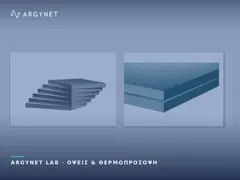
The Four Insulation Materials
System Materials & Basic Details
System Selection
Is your project over 500 m? If so, you are not within the map’s coverage area.
Request a Technical Quotation