CERESIT CERETHERM WOOL CLASSIC External Thermal Insulation
Last updated:
Stone wool is non-combustible — however, the system only achieves an A2 rating when used with mineral or silicone-based render. The render is not an aesthetic c
The system at a glance
- FIBRANgeo BP-ETICS | Stone wool for External Thermal Insulation
- FIBRANgeo BP ETICSplus | Stone wool for External Thermal Insulation
- KLIMAS LTX10 | Thermal Insulation Plugs
- CERESIT CT 180 MW STRONG FIX | Stone wool adhesive mortar
- CERESIT CT 190 MW FLEX | Adhesive mortar and base coat for stone wool
- CERESIT CT 327 | Glass fibre mesh
- CERESIT CT 16 | Acrylic primer
- CERESIT CT 74 | Silicone-based finishing render
- CERESIT CT 174 | Silicone-based – Silicate rendering
- CERESIT CT 48 Silicone-based Paint
- CERESIT CT 49 | Nano-silicone-based paint
- CERESIT CT 54 | Silicate Paint
- CERESIT Thermo Universal | Fibre-reinforced base coat mortar
Solutions & Applications · External Thermal Insulation
The external thermal insulation system is not a list of materials — it is a certified combination. The ETA approval covers this specific layer composition; replacing a single component with an equivalent product from another manufacturer invalidates the certification, not merely the guarantee.
Why stone wool?
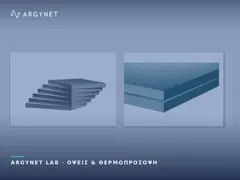
WOOL CLASSIC is the breathable system in the Ceretherm range, featuring stone wool insulation. It is chosen where moisture management and reaction to fire take precedence over cost:
- Exceptionally high water vapour permeability: the masonry continues to ‘breathe’ after insulation — a crucial factor in older buildings with natural moisture within the structure.
- Exceptionally high water resistance and hydrophobicity.
- BioProtect formula: resistance to mould, fungi and algae — on north-facing façades or in environments with high humidity.
- Resistance to mechanical damage, thermal stress and cracking.
- Flexibility that allows adaptation to uneven existing surfaces.
The system’s layering
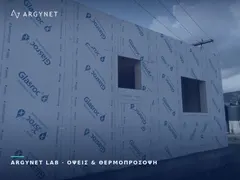
The six layers of Ceretherm Wool Classic, in the order of application from the substrate outwards:
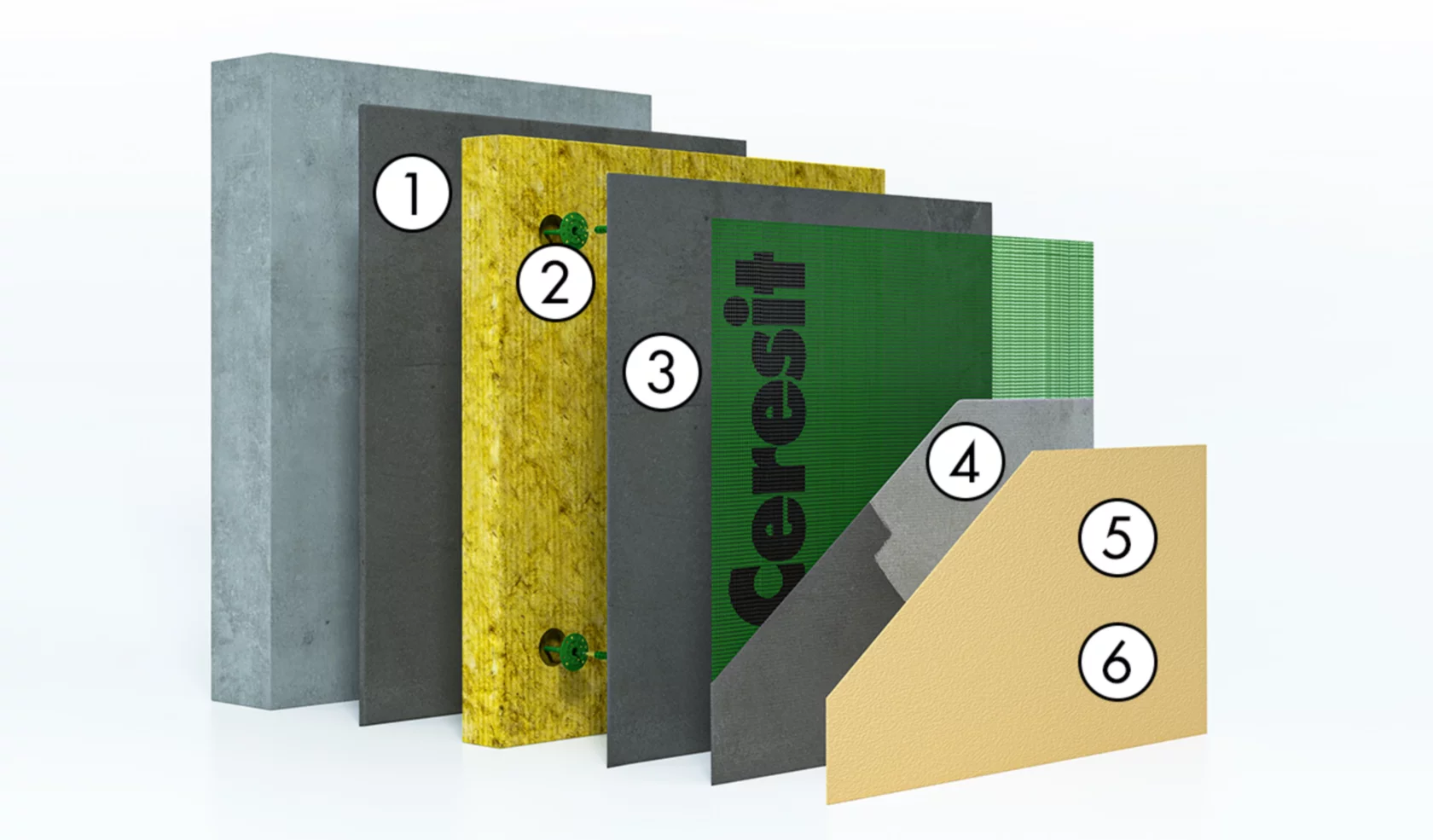
System diagram: Ceresit / Henkel
| Layer | Function | Material in the ARGYNET system |
|---|---|---|
| 1 · Fixing | Bonding the slab to the substrate | CERESIT CT 180 MW STRONG FIX or CT 190 MW FLEX · optionally THERMO UNIVERSAL |
| 2 · Thermal insulation material | Thermal resistance & vapour permeability | FIBRANgeo BP-ETICS or BP-ETICSplus · mechanical fixing with KLIMAS LTX10 plugs and FIBRAN CAPS cover caps |
| 3 · Reinforced mortar | Base layer that absorbs stresses | CERESIT CT 190 MW FLEX with embedded glass fibre mesh |
| 4 · Primer | Adhesion & uniformity of absorbency | CERESIT CT 16 (acrylic) — for silicate renders, a silicate primer is used |
| 5 · Final render | Decorative & protective layer | CERESIT CT 74 (silicone-based) or CT 174 (silicone-silicate-based) |
| 6 · Colour | Final protection & colour finish | CERESIT CT 48 (silicone-based), CT 49 Silix XD® (nano-silicone) or CT 54 (silicate) |
Stone wool is a non-combustible material — however, the classification of the system is determined by its combination with the final render. According to the technical data sheet for the silicone-based render CERESIT CT 74, WOOL CLASSIC with CT 74 is classified as B-s1,d0 in accordance with EN 13501-1. The Ceresit Ceretherm Universal MW system achieves an A2-s1,d0 classification when used with CT 74.
In practice: if the fire protection design requires A2, the answer is not ‘stone wool’ in general — it is a specific system with a specific render, which must be confirmed by the ETA for that combination before placing an order.
At ARGYNET, we specify the entire system and calculate materials per m².
Colour selection: breathability and contaminants
Layer 6 is not decorative. In a breathable stone wool system, a paint with low water vapour permeability negates the key advantage of the entire choice — moisture becomes trapped behind the top coat.
- CERESIT CT 49 Silix XD®: a nano-silicone-based product, highly permeable to water vapour with very limited absorption of water and dirt. Self-cleaning and resistant to atmospheric pollution, ultraviolet radiation and the growth of fungi, algae and mould. Recommended for listed buildings, renovations and breathable renders.
- CERESIT CT 48: silicone-based, hydrophobic and vapour-permeable — the standard choice for this system.
- CERESIT CT 54: silicate, for mineral substrates and silicate renders.
In a busy urban environment, the self-cleaning action of CT 49 translates into fewer façade maintenance interventions over the course of a decade — a life-cycle cost consideration, not an aesthetic one.
Points where the system fails
- Involvement of manufacturers: the ETA approval covers the certified combination. An ‘equivalent’ mesh or primer from another company invalidates the system’s certification.
- Number and arrangement of plugs: these are determined by the specifier based on an analysis of the substrate and a calculation of wind pressure loads — not by a fixed number per m².
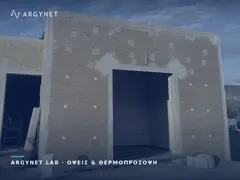
- Plug caps: without these, the head of the plug is visible on the finished surface, acting as a thermal bridge and leaving a visible mark.
- Position of the glass fibre mesh: it is embedded in the upper third of the base layer. A mesh resting on the insulation does not absorb stresses and the system will crack.
- Primer before rendering: this is often omitted to save money. The result is uneven absorption and visible differences in colour on the façade.
- Dark shades: the reflectance of the selected shade is checked; below a certain threshold, a system resistant to thermal stress is required.
When to use WOOL CLASSIC and when to use another system
| Project contract | Field of specialisation |
|---|---|
| Requirement A2 in the fire protection design | System achieving A2 classification under the ETA for the combination — with CT 74: Ceretherm Universal MW |
| An old building with structural damp | WOOL CLASSIC — breathable system |
| North-facing façade or high humidity | WOOL CLASSIC με BioProtect |
| Ground floor, pavement level, areas subject to impact | Enhanced impact resistance system |
| Dark-coloured façade finishes | System featuring heat-reflective technology (Solar Protect) |
| Seismic reinforcement of infill masonry | ETICS system with XPS |
| The most cost-effective solution, with no specific requirements | CERESIT POPULAR με EPS |
System Materials
Related Solutions from ARGYNET LAB
Does the fire protection design require A2? The classification is determined by the combination of the system and the render — and is verified in the ETA.
Request a Technical Quotation